


Fascia and Biomechanics: Global Architecture of Tension and Movement Integrity
1. Introduction and Relevance
Fascia is a system of connective tissue that envelopes every muscle cell, every fiber, and every organ in our body, creating a continuous three-dimensional network. For a long time, it was considered merely a passive "wrapper," but modern science views fascia as a full-fledged sensory organ and the primary mechanism of force transmission. In sports, fascial health determines your flexibility, explosive power, and injury resilience, as it is the fascia that distributes the load, preventing the overloading of individual muscles.
The relevance of this topic stems from the fact that most chronic pain and movement restrictions in athletes are related not to the muscles themselves, but to adhesions (sticking) and densifications within the fascial layers. Understanding fascial biomechanics allows for a shift from isolated exercises to integrated whole-body training as a single cohesive unit. This is the key to true functionality and "smart" strength that does not vanish with age.
Fascia is the biological fabric that turns your muscles into a single symphony of movement. Without healthy fascia, you are just a collection of separate parts; with it, you are a perfect athletic mechanism.
In this article, we will analyze the anatomical structure of fascia, break down the concept of tensegrity (tension integrity), and provide an expert methodology for fascial training to improve athletic performance.
2. History and Evolution of Views
For centuries, during dissections, anatomists removed fascia as "white noise" to better see the muscles and organs. The first serious steps in studying fascia were made in osteopathy at the beginning of the 20th century. However, a true revolution occurred with the publication of Thomas Myers' book "Anatomy Trains," which showed that muscles do not work in isolation but are connected in long fascial chains (meridians) stretching from the feet to the skull.
The evolution of views in the 2000s brought the understanding that fascia has the ability to contract independently of muscles (thanks to myofibroblasts). This changed the perception of warm-ups and rehabilitation. We realized that static stretching is not always beneficial, as it can reduce the fascial elasticity required for explosive movements.
Today, we are in the stage of "fascial mainstream." MFR (myofascial release), plyometrics, and specific tissue hydration exercises have become part of the preparation for world-class athletes. We have moved from linear mechanics to complex biological tension models, where every change in one node of the body resonates throughout the entire organism.

3. Anatomy and Histology of the Fascial Network
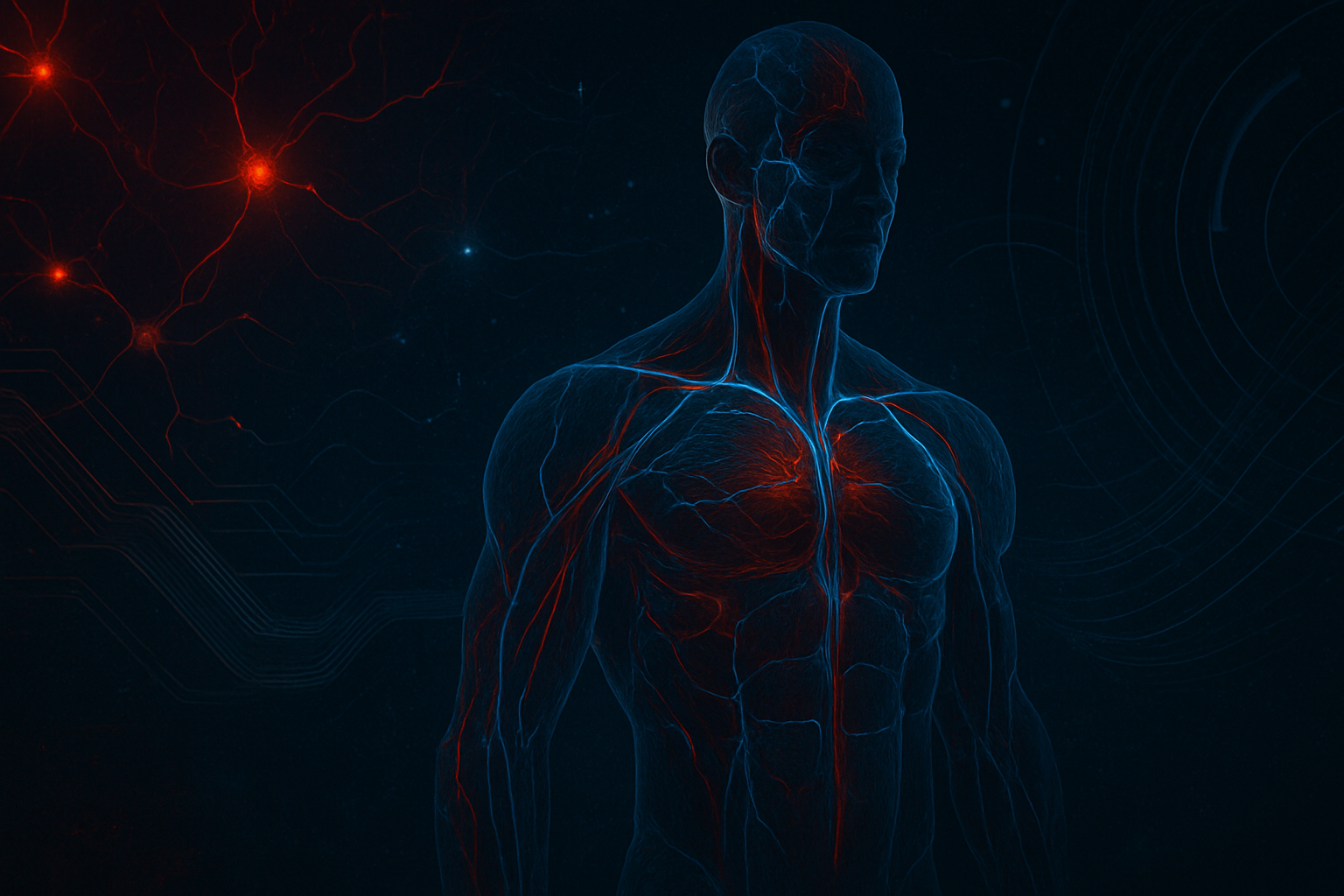
Anatomically, fascia is divided into superficial (subcutaneous), deep (which envelopes muscles—epimysium, perimysium, endomysium), and visceral (which supports organs). Histologically, it is a composite of collagen fibers (strength), elastin (elasticity), and extracellular matrix, which is 70% water and hyaluronic acid. In a healthy state, fascial layers glide easily relative to one another, ensuring smoothness of movement.
A key feature of fascia is its neuroanatomy. Fascia contains 6-10 times more sensory receptors (proprioceptors and nociceptors) than muscle tissue. This makes it our primary organ for "body sense" in space. When you perform a complex movement, it is the fascia that sends an instant report to the brain regarding angles, tension, and the potential danger of injury.
- Tensegrity
- An architectural principle where structural stability is ensured by a balance of tension (fascia) and compression (bones).
- Fascial Hydration
- The ability of tissues to hold water. Dehydrated fascia becomes brittle and prone to micro-tears.
Biomechanical Mechanics: Biomechanically, fascia works as a "biological spring." During running or jumping, it stores elastic deformation energy and instantly releases it, allowing the athlete to perform the movement with less muscle energy expenditure (the recoil effect).
4. Biochemistry of Fascial Adaptation
Fascial biochemistry is centered around the exchange of collagen and hyaluronic acid. Fibrocytes—the primary cells of the fascia—constantly monitor mechanical load. If the load is insufficient, the fascia becomes loose and weak. If the load is excessive or repetitive, fibrocytes begin to produce collagen intensely, leading to fibrosis—the tissue becomes stiff and "woody."
Hyaluronic acid in the fascia serves as a lubricant. Upon tissue acidification (for example, after a heavy workout), hyaluronic acid can change its state from liquid to gel-like, which impairs the gliding of fascial layers. This is the biochemical explanation for the feeling of stiffness the day after the gym.
| Collagen Type | Biochemical Function | Localization |
|---|---|---|
| Type I | Resistance to tension, strength | Tendons, deep fascia |
| Type III | Elasticity, regeneration | Superficial fascia, muscles |
| Hyaluronan | Lubrication, hydration | Interfascial spaces |
The biochemical response to MFR (foam rolling) lies in the temporary change in fluid pressure in the matrix, which "thins" the hyaluronic gel and returns mobility to the tissues. This is not the stretching of fibers, but biochemical rehydration of the structure.
Fascial Tensegrity: Tension Distribution & Elastic Recoil
Biomechanical tensegrity model of fascial lines: distribute axial stress across the superficial back line and maximize elastic kinetic recoil.
Launch Tool5. Practical Methodology of Fascial Training
Fascial Work Methodology: Fascial work methodology requires abandoning a narrow focus on muscles. Fascia "loves" whole-body movements that engage long kinetic chains. Static exercises hardly train the fascia; it requires dynamics, changes in tempo, and multi-vector movements.
- Plyometrics: Light jumps with minimal ground contact time train the "springiness" of the tendons and fascia of the legs.
- Full Range of Motion: Working at the extreme points of stretch strengthens the fascial sheaths, preventing their rupture under critical loads.
- Movement Variety: Perform habitual exercises at unusual angles. This forces the fascia to restructure its network in different directions, making it universally strong.
Fascial training is an investment in your body for the next 20-30 years. Muscles can atrophy quickly, but strong and elastic fascia will maintain your posture and mobility into old age.
Technically, it is important to follow a "loading-rehydration" rhythm. After intense fascial stress, tissues need 48-72 hours to synthesize new collagen. Too frequent fascial training leads to the accumulation of micro-tears that do not have time to heal.
6. Load Progression and Fascial Trains
Load progression for fascia involves moving from simple isolated movements to complex three-dimensional patterns. For example, instead of a simple bicep curl, the athlete performs a movement that engages the entire anterior fascial line (from the foot through the abdomen to the shoulder). This creates a global tension progression that makes the body incredibly powerful in real-life and sports situations.
- Superficial Back Line: From the sole to the brow. Responsible for upright posture and jumping. Trained through deadlifts and hinges.
- Superficial Front Line: From the feet to the neck. Protects organs and is responsible for flexion. Trained through planks and hollow holds.
- Lateral Line: The sides of the body. Stabilizes us during walking and lateral movements.
The kinematics of movement in fascial training should be smooth and elastic. Avoid abrupt stops at the bottom point—use the stretch energy for a smooth transition into the concentric phase. This will teach your tissues to work as a single cushioning mechanism.
7. Scientific Basis and Modern Research
The evidence base for fascial biology is growing rapidly. Research by Dr. Robert Schleip (Ulm University) has confirmed that fascia contains cells capable of contraction, and this process is regulated not only by the nervous system but also by chemical stress factors (e.g., TGF-beta). This explains why we feel stiff during chronic psychological stress.
Other studies using high-resolution ultrasound have shown that in people with back pain, the fascial layers are displaced and have 25-30% less mobility (gliding). This scientifically confirms the effectiveness of MFR and mobility exercises for treating chronic pain syndromes.
Scientific data also points to the importance of hydration. Studies at the molecular level have shown that "old" fascia contains less bound water, making it brittle. Regular movement and sufficient fluid intake are fundamental biochemical factors in preserving the youth of the fascial network.
8. Synergy: Fascia, Nerves, and Muscles
Fascia is the main stage upon which the interaction of nerves and muscles unfolds. Proprioceptors embedded in the fascia instantly react to changes in tension. If the fascia is too stiff, it "mutes" these signals, and the brain stops understanding exactly where the limb is. This leads to a degradation of the neuromuscular connection and a drop in strength performance.
- MFR + Active Stretching: Foam rolling relaxes fascial layers, and stretching sets the correct tension vector for them.
- Breathing + Pelvic Fascia: Deep belly breathing biomechanically "massages" the internal fascia, improving blood circulation in the pelvis.
- Cold + Heat (Contrast): Improves the "pumping" function of the fascia, accelerating the removal of metabolic products from the intercellular space.
In nutrition, synergy manifests in the combination of collagen with Vitamin C and silicon. Vitamin C is a necessary cofactor for cross-linking collagen fibers, and silicon provides them with elasticity. Without these micronutrients, fascial training will be less effective, as the body will lack the biochemical bricks for repair.
9. Common Mistakes and Injury Prevention
The main mistake is excessive rolling (MFR) to the point of severe pain. Fascia reacts to intense pain with a protective spasm, leading to even more stiffness. MFR should be "comfortably painful" (7/10), not a form of torture. Another mistake is ignoring the fascia in favor of only "pumping muscle." A hypertrophied muscle in an overly tight fascial sheath is like a powerful engine in a chassis that is too small: it will quickly overheat and break.
- Static Stretching Before Strength Work: Temporarily relaxes the fascia, which reduces joint stability and explosive power.
- Repetitive Loads: Running only on a treadmill teaches the fascia to work in only one plane, making it vulnerable to turns.
- Water Deficiency: "Dry" fascia tears like paper instead of stretching like rubber.
Regarding Injury Prevention: remember that fascia adapts to loading over 6-24 months. This is much longer than muscles. If you progress rapidly in weights, your fascia may not have time to strengthen. Periodic weeks of "fascial detox" (yoga, swimming, light movement) are the best prophylaxis for tendon ruptures and fascial hernias.
Interactive Apps & Calculators for Article
Empirical mathematical algorithms and scientific formulas for sports optimization
Health & Rehabilitation
Plantar Fascia Strain & Windlass Mechanism
Evaluate tensile strain on the plantar aponeurosis during toe dorsiflexion and compute high-load Rathleff loading protocols.
 Sports Nutrition
US Navy Body Fat Calculator
Accurately estimate body fat % and lean muscle mass from neck, waist, hip, and height measurements.
10. FAQ: Questions and Answers
- Can I get rid of cellulite with fascial massage?
- Cellulite is often the result of uneven tension in the superficial fascia and fluid retention. MFR and hydration can significantly improve skin appearance by smoothing the fascial network.
- Why do bruises appear after MFR?
- This is a sign of capillary fragility or overly aggressive pressure. Massage should not traumatize vessels; bruises are a technical error.
- How do I know if my fascia is "tight"?
- If you feel stiffness that does not go away after a warm-up, or if joint movement has a "stepped" character instead of smooth gliding.
- Does yoga help the fascia?
- Yes, yoga is one of the best methods for multi-vector tensioning of fascial lines, making the entire network more adaptive.
- Can I take collagen for my fascia?
- Yes, taking collagen with Vitamin C provides fibroblasts with raw material. However, without mechanical stimulus (exercise), the collagen may not reach the target zones.
- What is fascial elasticity?
- It is the tissue's ability to return to its original form after stretching. This is the primary factor in your speed and ease of movement.