

Quadriceps: Anatomy of Power, Biomechanical Foundation of Locomotion, and Hypertrophy Strategies
1. Introduction and Fundamental Relevance
The quadriceps femoris (quads) is one of the most powerful, massive, and metabolically active muscle groups in the human body. The quadriceps occupies the entire anterior and partially the lateral surface of the thigh, playing a critical role in extending the leg at the knee joint and stabilizing the body during vertical loads. In everyday life, we use the quadriceps with every step, climbing stairs, or standing up from a chair. In sports practice, developed quadriceps are the foundation for explosive power in jumps, sprints, and, of course, in all types of squats.
The relevance of deep study of the quadriceps is driven by their complex biomechanical structure. Since one of the four muscle heads is biarticular (crosses two joints), quadriceps training requires an understanding of the position of not only the knee but also the hip joint. Unbalanced development of the different heads can lead to patellofemoral syndrome (kneecap pain) and other chronic injuries. In this article, we will examine how to build a training process that ensures not only an impressive "teardrop" volume above the knee but also the functional stability of the entire musculoskeletal system for decades to come.
The quadriceps are the engine of your body. Without powerful legs, any upper body strength cannot be effectively realized in movement.
2. Evolution and History: From Bipedalism to Athletic Records
The evolution of the quadriceps femoris is closely linked to the development of bipedalism. In primates that move on four limbs, the quadriceps is less developed compared to humans, as the primary load falls on the muscles of the arms and back. In humans, the quadriceps became the primary anti-gravity muscle that prevents the knee from buckling under the weight of one's own body and absorbs impact during running.
The development of the vastus medialis was key for the final phase of leg extension, allowing humans to make long journeys. In the history of athleticism, quadriceps development has traveled the path from neglect (in early 19th-century gymnastic systems) to the cult of massive legs in modern bodybuilding. Legends such as Tom Platz proved that the quadriceps are capable of incredible hypertrophy and endurance, performing squats with 200+ kg for dozens of repetitions. Today, the quadriceps are an object of close attention both in physiotherapy (ACL recovery) and in strength sports as the primary marker of an athlete's functional power.
3. Deep Anatomy and Biomechanics: Four Heads—One Goal
As the name implies, the muscle consists of four separate heads, each with its own origin point, but all merging into a single powerful quadriceps tendon.
- Rectus Femoris (m. Rectus femoris)
- The only biarticular muscle of the group. Originates at the anterior inferior iliac spine of the pelvic girdle. It not only extends the knee but also flexes the hip. This is why it is maximally active during leg lifts in front of you and when kicking a ball.
- Vastus Lateralis (m. Vastus lateralis)
- The largest head, forming the outer contour of the thigh. It takes the main load during deep squats and is responsible for lateral knee stability during side-to-side movements.
- Vastus Medialis (m. Vastus medialis)
- Forms the characteristic "teardrop" (VMO) on the inner side. Critically important for stabilizing the patella, especially in the last 15 degrees of full leg extension, preventing its subluxation.
- Vastus Intermedius (m. Vastus intermedius)
- Located deep beneath the rectus femoris. It provides the depth of the muscle mass and assists in knee extension from the dead point, creating pressure on the joint capsule.
Biomechanical Mechanics: Biomechanically, the quadriceps works as a third-class lever. Since the tendon attaches close to the joint axis, the muscle must develop internal force 5-7 times greater than the external load to overcome resistance.
4. Biochemical Influence: Hormonal Cascade and Metabolism
Quadriceps training triggers the most powerful systemic biochemical response in the body. Due to the enormous cross-sectional area, leg work is accompanied by a significant release of anabolic growth factors (IGF-1 and mechanical growth factor) into the general circulation. This makes leg training beneficial for muscle growth even in the arms and shoulders. Biochemically, this process is accompanied by active glucose consumption and glycogen synthesis during the period of supercompensation.
During intense squats, massive glycolysis occurs in the quadriceps. The accumulation of lactate and hydrogen ions creates strong local acidosis, which stimulates hypertrophy through the mechanism of cellular swelling and activation of the mTOR pathway. Quadriceps are rich in myoglobin, allowing them to adapt to both prolonged aerobic loads (cycling) and explosive work modes.
| Muscle Fiber Type | Quadriceps Proportion | Physiological Role |
|---|---|---|
| Type I (Slow) | ~45-50% | Postural support, walking, endurance |
| Type IIa (Fast Oxidative) | ~35% | Strength endurance, squats for 10-15 reps |
| Type IIb (Fast Glycolytic) | ~15-20% | Explosive power, sprinting, 1-3 rep max weight |
1RM & Bench Press Calculator
Calculate your One-Rep Max using 7 scientific formulas, percentage table (50-95%), and barbell plate loader visualizer.
Launch Tool5. Practical Methodology: Hack Squats and Sissy Style
For full quadriceps development, it is necessary to use exercises that load the muscles at different stretch angles and with different force vectors.
1. **Barbell Squats (High Bar):** Upright torso position and deep squat maximize the stretch of all four heads. This is the baseline for building overall thigh mass. 2. **Front Squats:** By shifting the center of gravity forward, the load shifts from the glutes directly to the lateral and medial heads of the quadriceps. 3. **Hack Squats:** Eliminate the balance factor, allowing for focus on isolated leg work to total metabolic failure. 4. **Leg Extensions:** The only exercise where maximum peak contraction of the rectus femoris and the "teardrop" can be achieved without synergist involvement. 5. **Sissy Squats:** A unique movement that allows for maximal quadriceps stretch under load, mimicking work in a state of fascial over-tension.
If you don't feel the quadriceps "burning" after a set, you are either not squatting deep enough or you are using too much momentum and auxiliary muscles.
6. Load Progression and Leg Hypertrophy Strategy
The quadriceps are muscles that love both heavy weights and high volume.
- **Strength Phase:** Squats for 3-5 repetitions with weight at 80-90% of maximum. Goal—recruitment of high-threshold motor units and strengthening of tendons. - **Hypertrophy Phase:** Working in the 8-12 repetition range (leg presses, lunges). Goal—mechanical tension and sarcomere micro-trauma to stimulate protein synthesis. - **Metabolic Stress Phase:** High-repetition sets (20+) or drop sets. Goal—maximum pump and lactate response, stimulating capillarization and sarcoplasmic growth.
It is recommended to train the quadriceps separately from the hamstrings or to emphasize them in the first half of a leg workout while your central nervous system (CNS) is fresh and ready for heavy compound work.
7. Analysis of Scientific Research: Depth and Amplitude
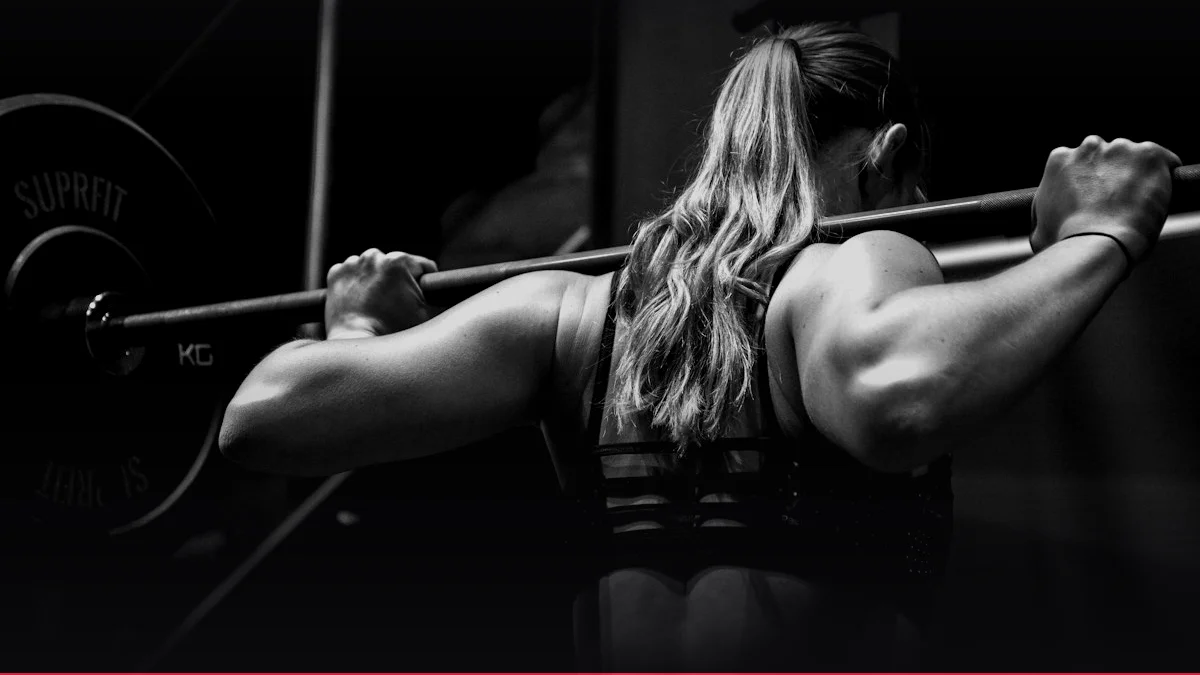
EMG studies (University of Tokyo, 2018) show that squat depth directly correlates with the level of quadriceps hypertrophy. "Parallel" squats activate muscles significantly less than "ass to grass" (full knee flexion) squats. Another interesting study (Brad Schoenfeld) compared squats and leg presses: it turned out that squats provide significantly higher activation of the rectus femoris due to the need for pelvic stabilization by the core.
It is also scientifically proven that limited ankle mobility leads to premature forward torso tilt, which removes load from the legs and transfers it to the lower back. The use of weightlifting shoes (shoes with a solid heel) is scientifically justified for redistributing the force vector directly to the quadriceps by artificially increasing dorsiflexion.
8. Synergy: Nutraceuticals, Creatine, and Recovery of Large Muscles
Recovering after a leg workout requires colossal resources and specific micronutrients. - **Creatine Monohydrate:** Quadriceps are the largest consumer of phosphocreatine. Creatine allows for performing explosive squats with heavier weights and accelerates ATP resynthesis. - **Beta-alanine:** Helps buffer lactate, which is critical for high-repetition squats, allowing for the delay of muscle failure. - **Carbohydrates (Glycogen):** Quadriceps are the main glycogen depot in the body. A low-carb diet will make leg training ineffective and increase injury risk. - **Magnesium and Zinc:** Necessary for muscle fiber relaxation and hormonal support after stressful loads.
9. Critical Mistakes, Myths, and Prevention of Knee Injuries
The most dangerous mistake is the "butt wink" at the bottom point of the squat. This occurs due to poor hip mobility and leads to lumbar hernias.
- Knee Valgus: Creates critical load on the ACL. Knees must always move in the plane of the foot for meniscus safety.
- Heels Lifting: Transfers load to the knee ligaments, injuring the joint capsule. Solution—work on ankle flexibility.
- Incomplete Range of Motion: Limits growth potential and creates a strength imbalance between the quadriceps and glutes.
- The Myth of Knees Past Toes: For athletes with long femurs, knees going past the toes is a biomechanical necessity to maintain the center of gravity.
Interactive Apps & Calculators for Article
Empirical mathematical algorithms and scientific formulas for sports optimization
10. FAQ: Expert Answers to Key Questions
- Can I build quadriceps with only leg extensions?
- No. Isolation will help with definition and patellar stabilization, but for real mass, heavy presses and free-weight squats are necessary.
- Why do my glutes hurt after squats, not my quads?
- Likely, you are leaning your torso too much or placing your feet too wide. Try front squats to shift the emphasis to the anterior surface.
- Does running help with quadriceps growth?
- Only sprinting and hill running. Marathon running, conversely, reduces muscle volume to increase the metabolic efficiency of movements.
- How can I avoid knee pain after training?
- Monitor your warm-up and technique. Often, knee pain is a consequence of weak gluteal muscles or chronic tightness in the vastus lateralis.
- What is the optimal frequency for leg training?
- For a natural athlete—1-2 times a week, considering the long recovery time of large muscle masses and the CNS.
- Can I train quadriceps if I have back pain?
- Yes, using exercises without axial load: leg press with proper pelvic fixation or seated leg extensions.
- Which is better: free weights or leg machines?
- Free weights build overall stability and functionality; machines allow for safely pushing a specific muscle to total metabolic failure.
- Does flat feet affect quadriceps work?
- Yes, flat feet lead to the knee collapsing inward, which reduces Vastus Medialis activation and increases the risk of knee joint injury.
Quadriceps are the foundation of your athletic power and a symbol of whole-body health. Train them hard, squat deep, and remember the balance between strength and flexibility. Only such an approach will provide you with a monolithic base for any sporting achievements for many years.