


Muscle Ruptures: Injury Classification, Mechanisms of Macro-damage, and Rehabilitation Protocols
1. Introduction and Relevance
A muscle rupture is one of the most dramatic and painful moments in the life of any athlete. Unlike ordinary "soreness," a rupture means the structural destruction of a large number of muscle fibers, accompanied by internal bleeding, swelling, and an instant loss of functionality. In sports medicine, **muscle ruptures** are classified as serious injuries that require not only rest but also competent, multi-stage rehabilitation. Improper treatment of a rupture often leads to the formation of a coarse connective tissue scar, which permanently reduces muscle strength and makes it vulnerable to re-injury.
The relevance of the topic of ruptures today is driven by the growing popularity of explosive sports where muscles work at the limit of their physical capabilities. Most ruptures occur not due to muscle weakness, but due to a lack of coordination between antagonist muscles or because fatigue signals were ignored. Understanding the biological processes occurring in the damaged tissue—from the first second of injury to the formation of new myofibrils—is key to a successful return to sport without loss of performance.
In this article, we will break down the severity levels of ruptures, examine modern first aid protocols that have replaced outdated methods, and develop a recovery strategy based on the principles of mechanotransduction and progressive loading.
2. Rupture Classification: From Micro-tears to Complete Avulsion
The medical classification of muscle ruptures is typically divided into three main grades, depending on the scale of the damage.
- Grade I (Micro-tear)
- Fewer than 5% of muscle fibers are damaged. The athlete feels sharp pain but can continue moving with limitation. Strength is almost not lost. Recovery takes 1 to 2 weeks.
- Grade II (Partial Rupture)
- A significant portion of fibers is torn (from 5% to 50%). Pronounced swelling is present, often with a hematoma (bruising). The pain is sharp, and muscle function is significantly restricted. A small "pit" may be felt in the muscle upon palpation. Recovery lasts 4-8 weeks.
- Grade III (Full Rupture or Avulsion)
- A complete tear of the muscle belly or a tendon avulsion from the bone. It is accompanied by a "pop" sound, unbearable pain, and a total inability to contract the muscle. Deformation is often observed—the muscle "bunches up" into a ball. This requires surgical intervention and rehabilitation for up to 6-12 months.
It is important to understand that the severity of the injury does not always correlate with the level of pain in the first minutes. Some complete ruptures may be accompanied by shock-induced numbness, while partial ruptures cause intense spasms.

3. Rupture Biomechanics: The Eccentric Phase and "Unnatural" Force Vectors
Why does a muscle tear? Biomechanically, this almost always happens during **eccentric contraction**, when the muscle attempts to contract but an external force forces it to lengthen.
- Loading Speed: The faster the stretch occurs under load, the higher the risk of rupture. This is why sprinters often tear their hamstrings at the moment of the leg swing.
- Muscle Length: Ruptures most often happen when the muscle is in its maximally stretched state (e.g., at the bottom of a squat or the lowest point of a bench press).
- Stabilizer Fatigue: When small stabilizer muscles fatigue, the primary muscle is forced to take on load vectors it is not naturally designed for (twisting, shearing), for which it is anatomically unprepared.
A biomechanical risk factor is also a "cold" muscle. Without a warm-up, the viscosity of intramuscular fluid is higher and the elasticity of the fibers is lower. This makes the muscle similar to brittle ice that cracks instead of bending.
4. Histology of Healing: Inflammation, Proliferation, and Scar Tissue Formation
Muscle healing after a rupture passes through three distinct biological stages.
- Destruction and Inflammation Phase (Days 1-3)
- Destroyed fibers become necrotic. Macrophages and neutrophils clear the zone of cell debris. This is the phase of swelling and pain. The primary task is to stop internal bleeding and limit the spread of inflammation.
- Regeneration and Proliferation Phase (Days 4-21)
- Satellite cells begin building new muscle tubes. Simultaneously, fibroblasts start producing collagen, creating a "bridge" between the edges of the rupture. This bridge is still very weak.
- Remodeling Phase (From Day 21 to several months)
- New fibers mature and become stronger. The collagen scar reorganizes along the lines of tension. If there is no movement at this stage, the scar becomes chaotic and rigid, which will permanently limit muscle function.
A muscle heals not just with time, but with correct loading. Without stress, new fibers will grow weak and disorganized.
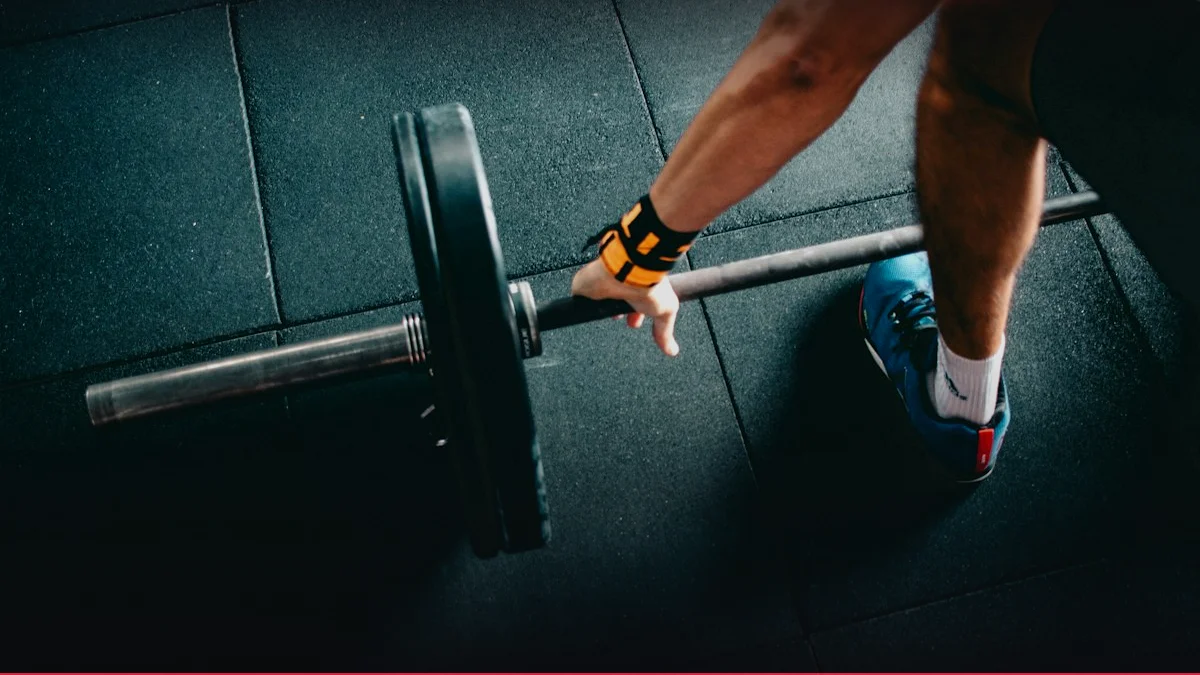
1RM & Bench Press Calculator
Calculate your One-Rep Max using 7 scientific formulas, percentage table (50-95%), and barbell plate loader visualizer.
Launch Tool5. Risk Factors: Antagonist Imbalance, Dehydration, and Steroid Fragility
Why do some people tear more often than others? There are several physiological factors that make muscles brittle.
- Strength Imbalance (Agonist/Antagonist): For example, if your quadriceps are much stronger than your hamstrings, they can simply "overpower" and tear the antagonist during a rapid movement.
- Dehydration and Electrolyte Deficiency: A lack of water and magnesium/potassium makes the muscle membrane unstable and prone to spasms. A spasmed muscle tears instantly under sudden load.
- Influence of AAS (Anabolic Androgenic Steroids): This is a serious risk factor. Steroids cause muscles to grow much faster than tendons and connective tissue can strengthen. The muscle becomes "too strong" for its own framework and detaches from the bone.
- Previous Injuries: A previously torn muscle that has healed with a scar is always a weak link, as the interface between the scar and healthy tissue has lower elasticity.
6. Practical Methodology: The PEACE & LOVE Protocol vs. Outdated RICE
For 40 years, the standard was the RICE protocol (Rest, Ice, Compression, Elevation). However, modern science has moved away from it because ice and complete rest slow down healing. The new standard is **PEACE & LOVE**.
| Phase | Action | Rationale |
|---|---|---|
| Protection | Protection (Days 1-3) | Avoid activities that cause pain. |
| Elevation | Elevation | Promotes fluid drainage and reduces swelling. |
| Avoid Anti-inflammatories | Avoid NSAIDs | Inflammation is necessary to initiate regeneration. |
| Compression | Compression (bandage) | Reduces internal bleeding and swelling. |
| Education | Education | Listen to the body; do not force progress. |
| Load | Load (after Day 3) | Gradual loading stimulates fiber growth. |
| Optimism | Optimism | Psychological state directly affects regeneration speed. |
| Vascularization | Vascularization | Pain-free cardio to improve blood flow to the injury site. |
| Exercise | Exercise | Restoration of range of motion and strength. |
7. Scientific Research Analysis: The Role of PRP Therapy and Growth Factors in Healing
One of the most promising directions in treating ruptures is PRP therapy (Platelet-Rich Plasma). Scientific studies (e.g., works by Bubnov et al.) show that injecting the athlete's own plasma, enriched with platelets, directly into the rupture site can shorten recovery time by 30-40%.
Platelets release growth factors (PDGF, TGF-beta, VEGF) that act as a "magnet" for satellite cells and stimulate the growth of new capillaries. This is critical for Grade II and III ruptures, where natural blood supply in the center of the hematoma is disrupted.
Another study confirmed the effectiveness of Low-Level Laser Therapy (LLLT) in stimulating mitochondria in damaged muscle cells, accelerating the ATP synthesis necessary for the energy-intensive process of protein regeneration.
Modern medicine does not just wait for the muscle to heal—it actively stimulates cellular regeneration at a biochemical level.
8. Synergy: Gradual Return to Load and the Role of Isometrics
Returning to the gym after a rupture is meticulous work. The synergy between biological healing and mechanical stimulus is built on three stages.
- Stage 1: Isometrics (Statics). When the muscle no longer hurts at rest, begin with muscle tension without movement (e.g., pressing your foot against a wall). This strengthens new fibers without stretching them.
- Stage 2: Concentric Phase with Low Range of Motion. Performing movement only on contraction with minimal weight. This improves blood circulation and "aligns" new fibers along the line of pull.
- Stage 3: Eccentric Phase (Negatives). This is the final and most dangerous stage. Gradual stretching of the muscle under load teaches the scar to be elastic. Only after full strength recovery in the eccentric phase can the athlete return to explosive movements.
This sequence avoids the formation of a "rigid scar," which is the primary reason athletes tear in the same spot a month after returning.
9. Common Mistakes, Myths, and Solutions
Errors in treating ruptures make the injury chronic.
- Too early massage of the rupture zone: Massage in the first 72 hours can increase bleeding and lead to myositis (ossification of the muscle). Solution: Only light lymphatic drainage above the injury site.
- Taking aspirin immediately after injury: Aspirin thins the blood, which increases the hematoma at the rupture site. Solution: Use only paracetamol for pain relief in the first 24 hours.
- Complete immobilization for weeks: This leads to atrophy and the formation of a coarse scar. Solution: Begin light movements without pain as early as day 3-4.
- Myth: "A muscle becomes stronger at the healing site after a rupture." No, it becomes less elastic. The scar site is always a zone of increased concern.
Interactive Apps & Calculators for Article
Empirical mathematical algorithms and scientific formulas for sports optimization
10. FAQ: Answers to Common Questions
- Can a Grade III full rupture be healed without surgery?
- For an ordinary person—sometimes yes, but the muscle will permanently lose a significant portion of strength and shape. For an athlete, surgery is usually mandatory to restore sporting performance.
- Why does a rupture turn blue and "slide" down the limb?
- Blood from ruptured vessels flows down due to gravity through intermuscular spaces. This is normal and does not mean the damage is spreading.
- How to tell if it's a rupture or just a spasm?
- In a rupture, you will feel a "sting" or "pop," the pain will be localized, and muscle function will disappear instantly. A spasm usually develops gradually and "releases" after stretching.
- Does taping help with ruptures?
- Yes, kinesio tape improves lymphatic drainage and gives the nervous system a sense of stability, which lowers the pain threshold.
- Which supplements speed up healing?
- Collagen + Vitamin C (for connective tissue synthesis), Omega-3 (for inflammation control), and sufficient protein.
A muscle rupture is a serious challenge, but with a competent approach, it is not the end of a career. Respect biological healing times, do not force the load, and remember: your body has an incredible capacity for recovery if you provide it with the right conditions and a smart stimulus.