

Brachialis: The Secret Weapon for Extreme Arm Thickness, Width, and Anatomy of M. Brachialis
1. Introduction and Fundamental Relevance
When we talk about arm development, the biceps is the first thing that comes to mind. However, many athletes face a problem where their arms look "flat" when viewed from the front, even if the biceps has a decent peak when viewed from the side. The reason lies in ignoring the muscle that lies deeper and is the true architect of the arm's width and power—the **Brachialis** (M. Brachialis). This muscle is the primary elbow flexor, and it is responsible for the overall "thickness" of the upper arm, literally pushing the biceps outward and creating that impressive 3D effect.
The relevance of brachialis training today is driven by the pursuit of harmonious and functional development of the upper limbs. Since the brachialis does not participate in supination (rotating the wrist), standard barbell biceps curls often leave it under-loaded. Its full activation requires specific angles and grips that often fall out of the amateur's field of vision. Moreover, a strong brachialis is a prerequisite for elbow tendon health, as it takes on a significant portion of the load during heavy pulling movements, protecting the distal biceps tendon from overload and micro-tears. In this article, we will analyze the anatomy, biomechanics, and methodologies for creating truly massive arms.
The brachialis is the jack for your biceps. The stronger it is, the higher your peak will be and the wider your arm will look from the front.
2. Anatomy and Function: Deep Layering and the Mechanics of Pure Flexion
The brachialis is a workhorse muscle that often goes unnoticed due to its deep location directly beneath the mass of the biceps brachii.
- Anatomical Location and Origin
- The brachialis is located directly on the anterior surface of the humerus. It originates from its lower half, covering a significant area of the bone, and attaches to the ulnar tuberosity (tuberositas ulnae).
- Critical Difference from the Biceps
- Unlike the biceps, the brachialis attaches to the ulna, which does not rotate around its axis during pronation or supination. This makes its work absolutely stable and independent of wrist position.
- Primary Role (Pure Flexion)
- It is the only major muscle whose function is pure flexion of the forearm at the elbow joint. It works like a "workhorse," generating huge force during any flexion.
- Synergy with the Coracobrachialis
- Together with the Coracobrachialis, they form the deep layer of arm muscles, providing stability to the humerus and joint capsule during strength movements.
Understanding that the brachialis attaches to the stationary (relative to rotation) ulna is the foundation for its entire training methodology. This is a muscle that always works but becomes the "leader" when we turn off the biceps via pronation.
3. Deep Biomechanics of "Pushing": How the Brachialis Creates 3D Volume
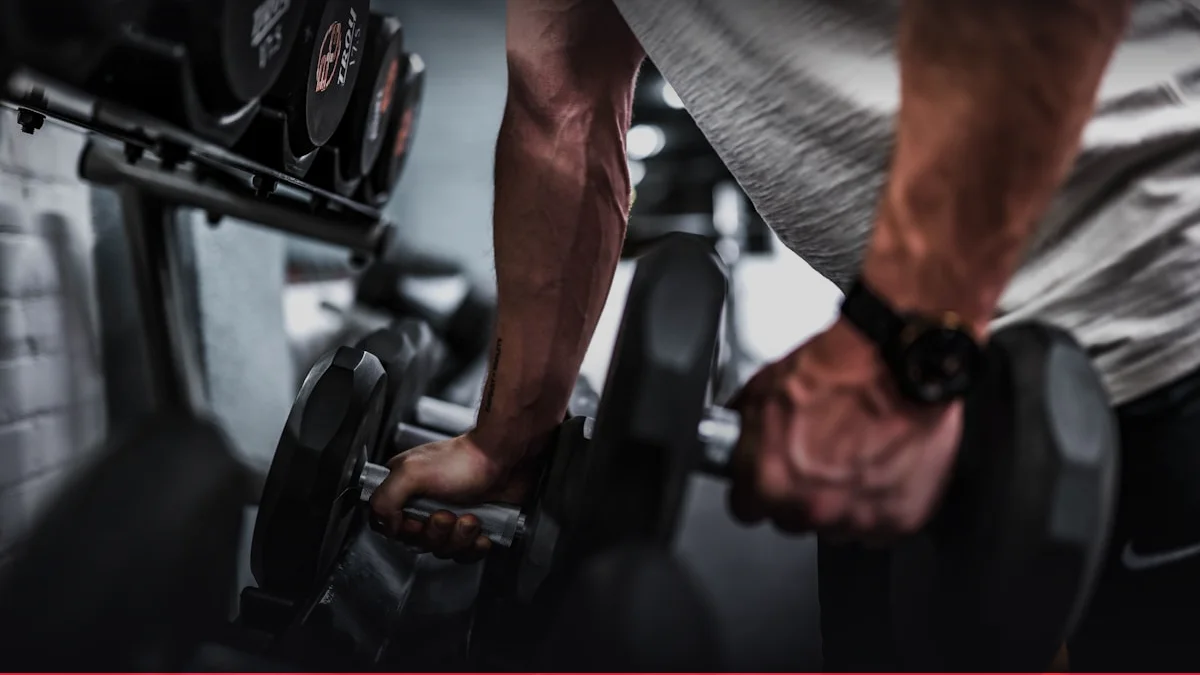
The visual effect of a developed brachialis is often compared to the action of a mechanical jack. When this muscle hypertrophies, its volume increases under the biceps, lifting it upward and outward relative to the bone.
- Width Effect: When viewed from the front, a developed brachialis looks like a separate muscle roll between the biceps and triceps. This visually broadens the arm in the middle of the upper arm, making it look monolithic.
- Mechanical Advantage: The brachialis has a better lever arm at an angle of 90-100 degrees. This is the zone of its maximum strength performance. That is why we can hold the most weight during flexion at this point.
- Elbow Stabilization: The brachialis protects the elbow joint from dislocation when carrying heavy weights (e.g., in a farmer's walk or heavy pull-ups).
Biomechanical Mechanics: Biomechanically, the brachialis is most active in the first quarter of the flexion range. Therefore, for its development, it is critically important to control the weight at the start of the movement from a full stretch, avoiding inertial "swinging" of the equipment.
4. Neurophysiological Aspect: Pronation as the Biceps "Off-Switch"
The main secret to isolating the brachialis lies in a neurophysiological phenomenon: the biceps becomes neurally weaker when the forearm is in a state of full pronation (palm down).
According to the Henneman Size Principle, the brain engages motor units depending on mechanical demand. When the biceps is placed in a mechanically disadvantaged position due to the tendon winding around the radius, the brain is forced to activate the high-threshold fibers of the brachialis to perform the flexion. This is why reverse-grip barbell curls feel significantly harder—you are working a muscle that is not used to isolated leadership. For maximum effect during hammer curls, the thumb should be kept strictly pointed upward. Biochemically, this creates a unique lactate response specifically in the deep muscle layers, stimulating the release of local growth factors into the synaptic clefts.
Brachialis vs Biceps Curl Isolation
Calculate torque distribution between brachialis and biceps brachii across neutral and pronated forearm angles.
Launch Tool5. Practical Methodology: Hammers, Zottman, and Cross-Body
For training the brachialis, there are several gold standards and specific exercises that should be alternated.
1. **Hammer Curls:** A neutral grip engages the brachialis and brachioradialis. Try the "Cross-body" variation, where you lift the dumbbell to the opposite shoulder—this activates the outer part of the brachialis even more. 2. **Reverse Curls:** Pronated grip (palms down). The most specific exercise for the brachialis. It is recommended to use an EZ-bar for an anatomically comfortable wrist position. 3. **Zottman Curls:** Lift supinated (biceps), lower pronated (brachialis). Ideal for emphasizing the negative phase and overloading the brachialis. 4. **Reverse-Grip Spider Curls:** Performing the exercise on an incline bench chest-down eliminates any assistance from the torso or inertia, creating isolation with "surgical" precision.
| Exercise | Grip Type | Repetition Range | Tempo (Eccentric/Pause) |
|---|---|---|---|
| Reverse EZ-Curls | Pronated | 10 - 15 | 3 sec down / 1 sec pause |
| Hammer Curls | Neutral | 8 - 12 | 2 sec down / 0 sec pause |
| Zottman Curls | Hybrid | 12 - 15 | 4 sec down (emphasis) |
| Cable Hammer Curls | Neutral (Rope) | 15 - 20 | Constant tension (TUT) |
6. Load Progression and the Role of Slow Negatives
The brachialis is an endurance-oriented muscle adapted for prolonged static work and weight support. Therefore, it requires a specific approach to intensity.
- **Eccentric Emphasis:** Since the brachialis is very strong in the negative phase, it responds well to slow lowering of the weight. Count to four during the descent of the bar. This creates micro-tears in the sarcomeres, stimulating further supercompensation. - **Constant Tension:** Do not relax the arms completely at the bottom point. Stop 10 degrees before full extension. This creates a state of local hypoxia, which enhances the anabolic response through the accumulation of metabolic byproducts. - **BFR Method (Blood Flow Restriction):** The brachialis responds well to training with blood flow restriction, allowing for muscle growth without using extreme weights, which is safe for the elbow joint.
Controlled negatives in reverse curls are the fastest path to thick forearms and a massive brachialis.
7. Scientific Research Analysis: EMG and Movement Speed
Studies (e.g., the work of Dr. T. Kuriyama in Japan) confirm that brachialis activation is 30% higher with a neutral grip compared to a supinated one. However, the most important discovery was that with full pronation, biceps activation drops by nearly half, making the brachialis the "main engine" of the movement.
Scientists also found that movement speed critically affects fiber selection in this zone. Slow movements (3-4 seconds) better activate the deep brachialis, while explosive dumbbell swings often shift the load to the long head of the biceps and the anterior deltoid. This emphasizes the importance of tempo discipline: if you want to train the brachialis, forget about speed; focus on the true "squeeze" of the muscle at every point of the range.
8. Synergy: Role of the Brachioradialis and Nutraceuticals
The brachialis works in tandem with the Brachioradialis, which forms the upper part of the forearm. Together they provide a powerful look to the arm in a relaxed state. - **Creatine and Hydration:** The brachialis is a dense muscle that requires high intracellular pressure. Creatine helps retain water in the cells, improving contraction mechanics and muscle fullness. - **Magnesium and Potassium:** Necessary to prevent cramps, which often occur in the brachialis due to its unusual loading in pronated grips and lactate accumulation. - **Collagen and Vitamin C:** Strengthen the distal brachialis tendon, which experiences colossal tension when working with heavy weights in hammer curls and negative repetitions. - **Citrulline Malate:** Improves blood flow in deep muscle layers, accelerating ammonia removal and enhancing the pump.
9. Critical Mistakes, Myths, and Preventing Tendonitis
- Wrist Assistance: Flexing the wrists upward during reverse curls removes load from the brachialis. Solution: keep the fist rigid.
- Torso Cheating: Swinging dumbbells in hammer curls. Solution: press elbows to the torso and keep the back stationary.
- Myth: "Brachialis is trained in pull-ups." Only if you pull up with a narrow neutral grip focusing on arm flexion rather than the back.
- Mistake: Excessively Heavy Weights. The brachialis is easy to injure due to the short lever arm. Work in the 10-15 repetition range with a focus on technique.
- Ignoring Warm-up: A cold brachialis is prone to inflammation at the attachment site on the ulna.
Interactive Apps & Calculators for Article
Empirical mathematical algorithms and scientific formulas for sports optimization
 Strength & Hypertrophy
1RM & Bench Press Calculator
Calculate your One-Rep Max using 7 scientific formulas, percentage table (50-95%), and barbell plate loader visualizer.
 Strength & Hypertrophy
RPE & Reps-In-Reserve Calculator
Calculate precise barbell working weight based on target RPE (6-10) and Reps in Reserve.
10. FAQ: Expert Answers to Key Questions
- Can a developed brachialis visually shorten my biceps?
- No, this is a myth. On the contrary, it lifts the biceps up, making its peak higher, sharper, and visually more effective. This creates volume where it is usually lacking.
- Which exercise is best for the biceps peak through brachialis development?
- Preacher Hammer Curls. They provide ideal isolation and muscle stretch at an angle that does not allow the biceps to dominate.
- Why does the outer part of the elbow hurt after brachialis training?
- This could be a sign of overloading the brachioradialis or lateral epicondylitis. Reduce the weight and check if you are over-tensing the wrist.
- Can I train the brachialis together with the back?
- Yes, it is effective since it is already warmed up after pulling movements. Add 2-3 sets of reverse curls at the end of the session.
- How fast can one see results from brachialis training?
- First changes in arm thickness and width become noticeable after 6-8 weeks with regular specialized work twice a week.
- Does chalk help when training the brachialis?
- Yes, as the reverse grip is harder to maintain due to extensor weakness; chalk will help concentrate specifically on the flexion.
- Are there brachialis exercises without equipment?
- Yes, pull-ups on towels or thick ropes with a neutral grip create colossal tension on the brachialis and grip strength.
- Does genetics affect brachialis shape?
- Genetics determine the length of the muscle belly, but its thickness is always the result of correct strength training and nutrition.
The brachialis is a secret weapon that transforms your arms into a monolithic piece of athletic art. Do not ignore this muscle; add reverse and neutral grip work to your program, and you will be surprised how quickly your arms become truly massive, wide, and functionally strong.