

Crunches: The Foundation of a Defined Abs and Functional Core Stability
1. Introduction and Relevance
In the pursuit of the ideal body, "six-pack" abs have become a symbol of peak physical form and discipline. **Crunches** are perhaps the most famous and widespread exercise for developing the rectus abdominis. Despite a multitude of modern methodologies, classic crunches remain the benchmark for isolated abdominal work. This exercise allows for targeted training of the abdominal muscles, creating conditions for their hypertrophy and visual separation. However, the true value of crunches lies not only in aesthetics but also in creating a stable powerhouse for the entire body.
The relevance of crunches in modern training is driven by their ability to develop control over spinal flexion. For many people leading a sedentary lifestyle, abdominal muscles become weak and overstretched, leading to posture problems and lower back pain. Properly executed crunches help restore core tone, improve intra-abdominal pressure, and protect the spine during heavy daily movements. This is an exercise available to everyone, but it requires an intellectual approach to technique to achieve maximum results.
In this article, we will break down the biomechanical secrets of the perfect crunch, learn to exclude the hip flexors for maximal abdominal isolation, and find out how to structure the training process so that your stomach becomes the embodiment of strength, definition, and functional excellence.
2. History and Evolution of the Issue
Crunches have a long history that began long before the emergence of modern fitness clubs. As early as the beginning of the 20th century, athletes used various torso raises to strengthen the "shield" of the stomach. However, classic crunches in the form we know them were popularized in the 70s and 80s. Previously, the primary exercise was considered the straight-back sit-up, but physical therapists noticed that this movement overloaded the hip flexors and lower back while minimally engaging the abs themselves.
The evolution of the exercise led to an understanding of the importance of segmental spinal flexion. Athletes and doctors concluded that activating the rectus abdominis does not require lifting the entire torso; it is enough to just lift the shoulder blades off the floor, "crunching" the rib cage toward the pelvis. This radically changed training methodology, making it safer and more effective. Dozens of variations emerged: on a Swiss ball, with raised legs, with weights, and in special machines, allowing athletes to work every part of the abs.
Today, crunches are viewed as a fundamental exercise for core development in CrossFit, Pilates, and bodybuilding. Modern sports science has confirmed that this type of loading is the most natural for the rectus abdominis. The exercise has traveled from raw torso raises to a high-precision tool of sports physiology that ensures the health and beauty of the body.
3. Anatomy and Biomechanics of Spinal Flexion
Crunches engage the entire mass of abdominal muscles, focusing the load on the upper and middle parts of the abs.
- Rectus Abdominis
- The primary target muscle. It is responsible for bringing the rib cage closer to the pubic bone. This muscle creates the visual "six-pack."
- External and Internal Obliques
- Work as stabilizers, ensuring even flexion and preventing torso shifts during the movement.
- Transverse Abdominis
- A deep muscle lying beneath the rectus. It is responsible for a flat stomach and supporting intra-abdominal pressure.
- Hip Flexors (Iliopsoas)
- In proper crunches, their role should be minimized. When we lift the entire torso, they become dominant, which reduces the load on the abs.
- Serratus Anterior
- Helps stabilize the rib cage during intensive crunching, adding definition to the side of the torso.
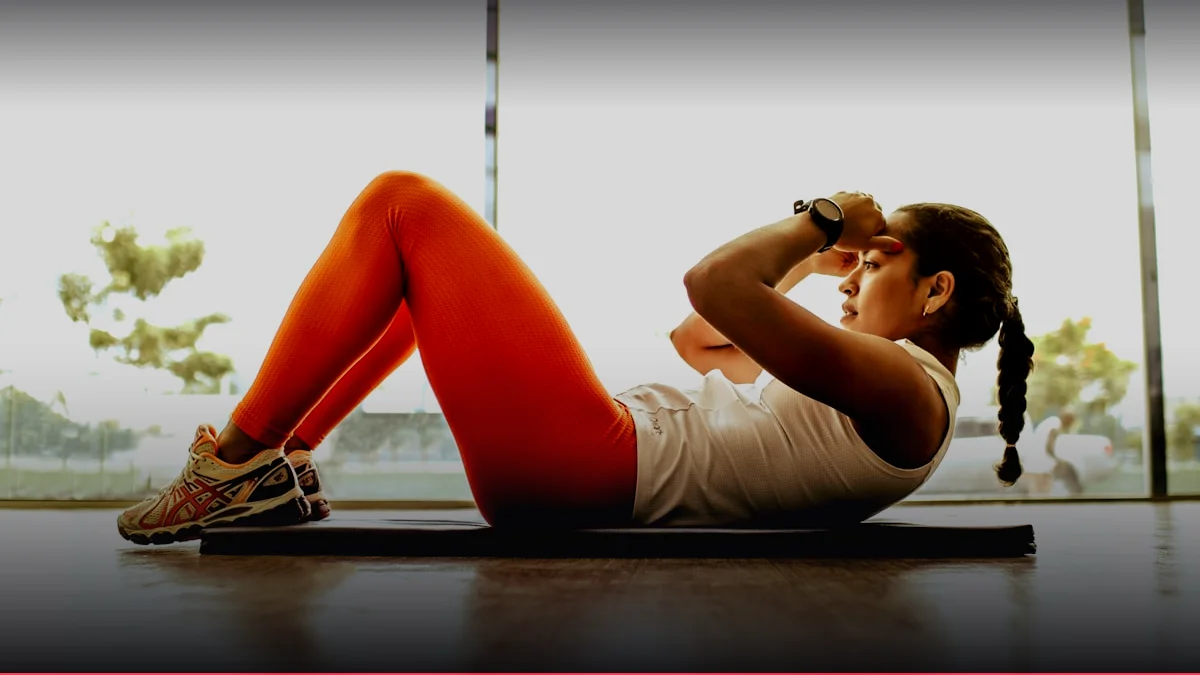
Biomechanical Mechanics: Biomechanically, a crunch is segmental spinal flexion in the thoracic and lumbar regions. The key point is that the movement should occur "inward," as if you want to roll yourself into a cylinder. The distance between the shoulder blades and the floor should be small—the height of the lift is not what matters, but the degree of muscle fiber contraction. The center of gravity should remain stationary, and all work should be performed exclusively by the abdominal muscles.
4. Biochemical Impact on the Organism: Metabolic Stress and Abdominal Separation
Performing crunches in the 15-25 repetition range creates a high level of metabolic stress, which is a key factor for abdominal detailing.
Biochemically, this process is accompanied by intensive accumulation of lactate (lactic acid) in the abdominal muscles. Due to prolonged tension, a local hypoxia effect arises, stimulating the release of growth factors and capillarization of the zone. This improves muscle nourishment and promotes visual separation of the rectus abdominis bundles. Although the exercise does not burn fat locally, it makes the muscle fibers denser, which, at a low body fat percentage, creates the desired definition.
Abs grow from the burn and show from the diet. Crunches are your tool for creating the pattern you will show the world.
It is also important to mention the impact on the CNS. Crunches require an ideal "mind-muscle" connection. Since the range of motion is small, the athlete must consciously tense the abs at every millimeter of the trajectory. This improves neuromuscular conduction and allows for better control of the stomach in daily life, automatically supporting posture.

Karvonen Heart Rate Reserve Zones
Calculate 5 personalized heart rate zones based on resting HR and aerobic reserve.
Launch Tool5. Practical Methodology and Execution Technique
The technique of crunches does not forgive haste or jerks. You must feel every muscle fiber of your stomach.
- Starting Position: Lie on your back, bend your knees (feet on the floor). Keep your hands near your temples or crossed on your chest. Do not lace your fingers behind your head!
- Beginning of the Movement: On an exhale, slowly begin to lift your shoulders and shoulder blades off the floor, crunching your torso toward your pelvis.
- Peak Contraction: At the top point, maximally contract the abs for 1 second. The lower back must remain pressed to the floor.
- The Return: On an inhale, smoothly and under control lower down, but do not touch the shoulder blades completely to the floor to maintain tension.
- Breathing: Exhale on the effort, inhale when stretching the muscle. This is critical for activating the deep layers of the abs.
| Parameter | Classic Crunches | Weighted Crunches |
|---|---|---|
| Repetition Count | 15-25 | 10-15 |
| Load Type | Metabolic stress | Mechanical tension |
| Amplitude | Short / Medium | Short / Controlled |
| Target Effect | Endurance / Definition | Hypertrophy / Density |
6. Load Progression and Integration into the Plan
Progression in abdominal training should be qualitative, not just quantitative.
- Increasing Repetitions: Aim to perform 30 perfect repetitions before making the exercise more difficult.
- Using Weights: Hold a plate or dumbbell weighing 2-5 kg over your chest. This will sharply increase mechanical tension.
- Leg Position Change: Raise your legs at a 90-degree angle. This will complicate pelvic stabilization and increase the load on the lower abs.
- Integration: Crunches are best placed at the end of a workout after basic exercises or as part of a core circuit. 3 times a week is quite sufficient for progress.
Important: For advanced athletes, it is effective to use crunches in a machine or on a pulley (Cable Crunch or "The Prayer"), which allows for working with heavy weights in a strength hypertrophy mode. However, the foundation always remains the same—segmental spinal flexion.
Don't count the reps that were easy. Count only those that made your abs beg for a stop.
7. Scientific Research Analysis and Evidence Base
EMG studies confirm that floor crunches provide activation of the rectus abdominis at 60-70% of maximum. Using a Swiss ball increases this marker to 80-85% due to the need to stabilize the torso in an unstable environment.
Scientific work on spinal health indicates that crunches are much safer than sit-ups, as they create significantly less torque in the lumbar region. However, scientists caution against performing thousands of repetitions daily, as an excessive number of flexions can lead to disc fatigue. Moderation and quality are key factors.
It has also been proven that activating the transverse abdominis during crunches (the "stomach vacuuming" method) significantly improves spinal stability and makes the waist appear visually narrower by strengthening the internal corset.
8. Synergy: Nutrition, Nutraceuticals, and Recovery
For your abs to become visible, you need not only technique but also quality support for the body.
- L-Carnitine
- Helps support energy metabolism during a calorie deficit, which is important for showing abdominal definition.
- Citrulline Malate
- Improves abdominal muscle capillarization, providing a better pump and nutrient delivery.
- Collagen + Vitamin C
- Necessary for the health of the abdominal fascia, which undergo constant stretching and compression.
- Magnesium
- Prevents cramps in the abdominal muscles, which often arise after intensive series of crunches.
Recovery after abdominal training should include light spinal stretching (Cobra pose in yoga) and using a foam roller to relieve tension from the back muscles. Quality sleep is critical for muscle fiber regeneration and realizing the result of your labor. Do not forget that the abs recover best with active rest and a balanced diet.
9. Common Mistakes, Myths, and Preventing Injury
The main mistake is pulling your head with your hands. This leads to overstraining the cervical vertebrae and turns off the abs. HANDS SHOULD ONLY TOUCH THE TEMPLES!
- Myth: Crunches burn stomach fat. (Reality: Fat is burned through a calorie deficit; the exercise only builds muscle under the fat).
- Mistake: Lifting the lower back off the floor. This shifts the load to the hip flexors and creates danger for the back.
- Myth: The more crunches, the better. (Reality: Better 20 quality repetitions than 200 made with inertia).
- Mistake: Holding your breath. Without an exhale on the effort, you cannot maximally contract the abdominal muscles.
To prevent injury, always keep your stomach drawn in. If you feel pain in your back, stop execution and check if you are correctly flexing your rib cage.
Interactive Apps & Calculators for Article
Empirical mathematical algorithms and scientific formulas for sports optimization
10. FAQ: Answers to Common Questions
- Can I do crunches every day?
- You can, but it is not recommended. Abs, like any muscle, need time to recover. 3-4 times a week is ideal.
- What is better: crunches or plank?
- These are different exercises. Crunches build shape and abdominal mass. Plank builds core stability and endurance. Combine them.
- Why does my neck hurt after the exercise?
- You are tensing your neck muscles too much or pulling your head with your hands. Try keeping your tongue on the roof of your mouth—this will help stabilize the neck.
- Do crunches help with back pain?
- Yes, strengthening the abs removes part of the load from the lower back, improving posture.
- What is the optimal weight for weighted crunches?
- Start with 2-5 kg. The main thing is that the weight doesn't prevent you from correctly flexing the spine segmentally.
Crunches are your path to ideal defined abs and functional core strength. Be technical, consistent, and patient, and your "six-pack" will become proof of your athletic mastery.