


Barbell Bicep Curl: A Mass-Building Classic and Iconic Arm Exercise
1. Introduction and Relevance
In the world of strength training, there are exercises that need no introduction. The **Barbell Bicep Curl** is perhaps the most famous movement in the gym, having become a symbol of athleticism and a muscular physique. Despite its apparent simplicity, this exercise is one of the most effective tools for building the massive and peaked form of the biceps brachii. It is the foundation upon which all arm aesthetics are built, and it allows for working with the heaviest weights among all bicep exercises.
The relevance of the barbell bicep curl in modern training is driven by its ability to create colossal mechanical tension and metabolic stress—two key drivers of hypertrophy. For many athletes, the free barbell is the tool that allows them to overcome genetic plateaus and give their arms a truly athletic look. Furthermore, this exercise strengthens the grip and forearms, which positively impacts results in all pulling movements, from pull-ups to deadlifts.
In this article, we will break down the biomechanical secrets of the perfect arm curl, learn to use different types of bars and grips for targeted activation of different bicep heads, and find out how to structure the training process so that your arms become the embodiment of strength and perfect form.
2. History and Evolution of the Issue
The barbell bicep curl is one of the oldest exercises in the strongman arsenal. As early as the beginning of the 20th century, legendary athletes like Eugen Sandow used heavy barbells to demonstrate the strength of their arms. In the 40s and 50s, with the rise of bodybuilding, this exercise became a central element of preparation. Stars of that time, like Reg Park, proved that big arms require big weights, and the barbell curl was the best means for this.
The evolution of the exercise led to the appearance of the EZ-bar (bent bar) in the mid-20th century. This was done to reduce the load on the wrists, which often became the limiting factor when using straight bars. In the 70s, Arnold Schwarzenegger popularized the "cheating" method—controlled swaying of the torso to overcome the "sticking point" with ultra-heavy weights. This allowed athletes to go beyond ordinary isolation and load the biceps significantly harder in the eccentric phase.
Today, the barbell bicep curl is considered a fundamental exercise in any training program. Modern sports science has confirmed that the supinated hand position (palms up) provided by the barbell is ideal for maximal activation of both bicep heads. The exercise has traveled from fairground weights to the high-precision methods of modern bodybuilding, remaining the king of arm training.
3. Anatomy and Biomechanics of the Barbell Arm Curl
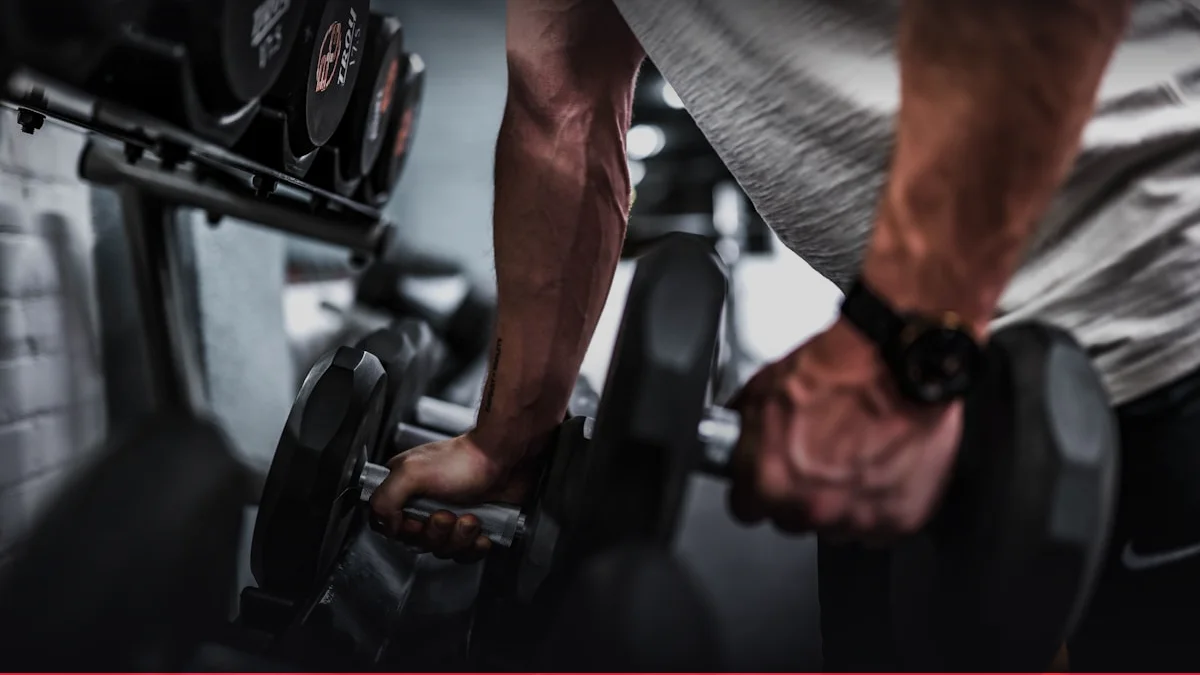
The barbell curl engages the entire complex of arm flexor muscles, focusing the load on the biceps.
- Biceps Brachii (Biceps)
- Has two heads: long (outer) and short (inner). A straight bar ideally activates both, creating overall volume and peak height.
- Brachialis
- Located under the biceps. It actively works during flexion, "pushing" the biceps outward and adding massiveness to the arm.
- Brachioradialis
- A forearm muscle that provides flexion at the elbow joint, especially when using an EZ-bar.
- Pronator Teres and Wrist Flexors
- Stabilize the barbell in the hands and ensure a reliable grip throughout the entire set.
- Core and Leg Muscles
- In a standing position, they work in isometric mode, keeping the torso stationary and preventing excessive swaying.
Biomechanical Mechanics: Biomechanically, the barbell curl is a single-joint movement (elbow flexion). The key point is the immobility of the elbows; they should be pressed to the sides or slightly forward. As soon as the elbows start moving back or too far forward, the load shifts to the anterior delts, which reduces the effectiveness of the exercise for the biceps. Maximum torque in this exercise occurs in the middle of the range (90-degree angle), which is the peak point of tension.
4. Biochemical Impact on the Organism: Metabolic Stress and Bicep Hypertrophy
The barbell bicep curl creates ideal conditions for combining mechanical tension and metabolic stress.
Biochemically, performing the exercise in the 8-12 repetition range leads to intensive accumulation of lactate and hydrogen ions in the muscle fibers of the arm. This causes cell swelling (pumping), which is a signal for the activation of satellite cells and the synthesis of new protein structures. Since the biceps contains a large number of fast-twitch muscle fibers, working with a barbell under heavy load stimulates their thickening, leading to rapid growth in arm volume.
The barbell curl is a challenge to your biceps. Every repetition made with perfect supination is a step toward legendary arms.
It is also important to mention the impact on the nervous system. The necessity of holding heavy weight in a supinated state requires high neural activity. The brain learns to create a powerful impulse to the flexors, improving the "mind-muscle" connection. This allows the athlete to better "feel" the biceps in any other exercises, making the entire training process more effective.

1RM & Bench Press Calculator
Calculate your One-Rep Max using 7 scientific formulas, percentage table (50-95%), and barbell plate loader visualizer.
Launch Tool5. Practical Methodology and Execution Technique
The technique of the barbell curl requires a total absence of inertia and strict control of the trajectory. Do not let your ego drive the weight!
- Starting Position: Stand straight, feet shoulder-width apart. Take the barbell with an underhand grip. Arms are fully extended, the bar touching the thighs. Back is straight, shoulder blades slightly retracted.
- The Lift: On an exhale, use the strength of the biceps to lift the barbell to shoulder level. Keep your elbows stationary at your sides. Do not shrug your shoulders upward.
- Peak Contraction: At the top point, maximally contract the biceps for 1 second. Do not touch the bar to your shoulders—maintain tension.
- The Return: On an inhale, slowly and under control lower the barbell down. The eccentric phase (lowering) should be twice as long as the lift.
- Breathing: Inhale while lowering, exhale while lifting. Do not hold your breath!
| Parameter | Straight Bar | EZ-Bar (Bent) |
|---|---|---|
| Bicep Activation | Maximum (Full supination) | Moderate |
| Wrist Load | High | Low (Anatomic) |
| Forearm Work | Minimal | Active (Brachioradialis) |
| Target Group | Advanced / Strength Athletes | Beginners / Injured Wrists |
6. Load Progression and Integration into the Plan
Progression in bicep training should be consistent but without losing form purity.
- Weight Increase: Add 1-2.5 kg to the barbell as soon as you can perform 12 perfect repetitions without torso swaying.
- Grip Change: A narrow grip (narrower than shoulders) loads the long head (outer) more. A wide grip loads the short head (inner).
- 21s Method: Perform 7 reps in the lower half of the range, 7 in the upper half, and 7 in the full range. This is extreme metabolic stress for the biceps.
- Integration: The barbell curl should be the first or second exercise in arm training. After it, dumbbell curls (hammers) or cable work follow perfectly.
Important: Use an Arm Blaster (a special support for the elbows) if you cannot keep your elbows stationary. This will help isolate the biceps 100% and prevent cheating.
The quality of every repetition is more important than the weight on the bar. Feel the muscle contract, not the weight move.
7. Scientific Research Analysis and Evidence Base
EMG studies confirm that the standing barbell bicep curl provides 15-20% higher activation of the biceps brachii compared to seated dumbbell curls at the same relative intensity. This is explained by the stability of the barbell and the ability to maintain full supination throughout the movement.
Scientific work on forearm training indicates that using a thick bar (Fat Gripz) in this exercise sharply increases the activation of the wrist flexor muscles, making the biceps appear visually more massive through the development of the brachioradialis.
Scientists also researched the role of the eccentric phase. It was established that athletes who lower the barbell over 3-4 seconds have 25% better muscle mass gains compared to those who just "drop" the weight down. This confirms the importance of control at every stage of the movement.
8. Synergy: Nutrition, Nutraceuticals, and Recovery
For arm growth and supporting elbow joint health, quality nutritional support is needed.
- Creatine Monohydrate
- Provides strength for heavy sets and promotes water retention in muscle cells, visually increasing arm volume.
- Citrulline Malate
- Improves bicep capillarization, providing an incredible pump and rapid metabolite removal after training.
- Collagen + Vitamin C
- Support the health of elbow tendons, which are subjected to significant tension during barbell work.
- Beta-Alanine
- Helps endure a large number of repetitions (especially in the "21s" method), delaying the burn.
Recovery after bicep training should include light stretching of the arm flexors and using a massage ball to relax the forearms. Quality sleep is mandatory for realizing the anabolic signal received during training. Do not forget that the biceps is a small muscle; it needs less time for recovery than the back, but more attention to detail.
9. Common Mistakes, Myths, and Preventing Injury
The main mistake is torso swaying ("cheating"). When you help yourself with your back, you remove the load from the biceps and risk injuring your lower back. KEEP YOUR TORSO STATIONARY!
- Myth: Only the biceps grow from the barbell curl. (Reality: The exercise strengthens the entire shoulder girdle and grip).
- Mistake: Elbows pulling away from the sides. This engages the shoulders and makes the exercise less effective for the arms.
- Myth: The EZ-bar is worse than the straight bar. (Reality: It is safer for many people and allows for working longer without wrist pain).
- Mistake: Fully extending the elbows to a "click" with heavy weight. This creates dangerous load on the ligaments.
To prevent injury, always start with a wrist and elbow warmup. If you feel sharp pain in your forearms, switch the straight bar for an EZ-bar or try dumbbell "Hammer Curls."
Interactive Apps & Calculators for Article
Empirical mathematical algorithms and scientific formulas for sports optimization

10. FAQ: Answers to Common Questions
- What is better: standing or seated barbell curl?
- Standing is the base for mass and strength. Seated is better for isolation as it excludes leg assistance.
- Can I build big arms with only this exercise?
- It is an excellent foundation, but for perfect form, exercises at other angles (e.g., on a Preacher Bench) are also needed.
- Why do my forearms hurt after the exercise?
- Likely, your wrists are not ready for a straight bar. Try an EZ-bar or reduce the weight.
- What is the optimal number of repetitions for growth?
- The 8-12 repetition range with perfect technique is considered the gold standard for hypertrophy.
- Can I do barbell curls every day?
- No, muscles need time to grow. 2 times a week is the ideal frequency for most athletes.
The barbell bicep curl is your key to legendary arms and athletic power. Be technical, consistent, and patient, and your results will surprise even the most experienced strongmen.