


Seal Row: The Gold Standard for Back Isolation Without Lower Back Stress
1. Introduction and Relevance
In the world of strength training, the bent-over barbell row is considered one of the best exercises for the back. However, it has one significant drawback: massive loading on the lower back, which often becomes the limiting factor. The **Seal Row** (Chest-Supported Row) is a unique solution that allows for the complete exclusion of leg assistance and lower back stress, concentrating 100% of the effort on the lats and middle back. This is an exercise that allows an athlete to work "to failure" without risking spinal health, making it an indispensable tool for both professional bodybuilders and athletes in rehabilitation.
The relevance of the Seal Row in modern training is driven by the growing popularity of intellectual bodybuilding, where the priority is targeted muscle activation. Unlike the ordinary row, where the athlete often uses torso inertia (cheating), the chest-supported row makes such assistance impossible. This creates conditions for incredible back detail and thickness, allowing for the working of the smallest muscle fibers. Furthermore, it is an ideal option for people with herniated or bulging discs who want to continue training the upper body heavily.
In this article, we will break down the biomechanical secrets of the perfect chest-supported row, learn how to build a trajectory for maximum muscle separation, and discover how to structure the training process so your back becomes the embodiment of strength, aesthetics, and functional perfection.
2. History and Evolution
The exercise earned its name "Seal Row" because of the specific leg position of the athlete on the bench, which often lie freely or hang, resembling flippers. Originally, it was used by weightlifters and powerlifters as an auxiliary movement for strengthening the upper back without accumulating fatigue in the lower back. During the "Golden Era" of bodybuilding in the 70s, athletes like Franco Columbu used various chest-supported row variations on high benches to achieve that incredible muscle detail that was their trademark.
The evolution of the exercise led to the creation of specialized Seal Row benches with adjustable heights and dedicated barbell holders. While previously athletes had to prop up an ordinary bench on plates or boxes, today's modern gyms offer ergonomic solutions for this movement. It was discovered that the chest-supported row is one of the few exercises that allows for reaching peak back muscle contraction without the slightest torso deviation, making it the benchmark for isolation.
Today, the Seal Row is a mandatory element in the preparation of athletes in sports requiring powerful pulling (rowing, wrestling). Modern sports science has confirmed that full horizontal torso support allows for significantly increased lat activation by eliminating energy losses on lower back stabilization. The exercise has traveled the path from makeshift constructions to a high-tech method for building the perfect back.
3. Anatomy and Biomechanics of Isolated Rowing
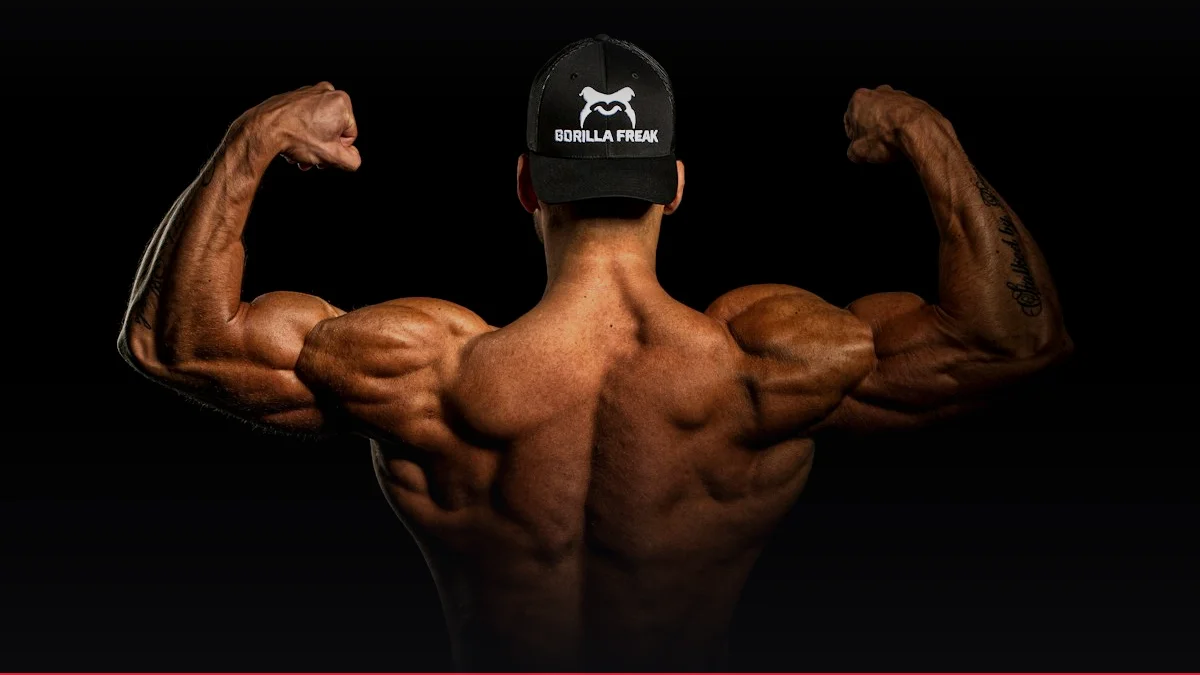
The chest-supported row focuses the load on the entire upper and middle back array, working on thickness and detail.
- Latissimus Dorsi (Lats)
- Receive the primary load in the initial and middle phases of the movement. The absence of cheating allows for maximum stretching at the bottom point.
- Rhomboids and Middle Trapezius
- Work at the peak of the range. The chest support allows the athlete to make a maximum pause at the shoulder blade retraction.
- Rear Delts and Teres Muscles
- Actively engaged when using a wider grip, ensuring a 3D shoulder girdle effect.
- Serratus Muscles and Serratus Anterior
- Help stabilize the scapula during the row, improving overall torso side detail.
- Biceps and Brachialis
- Work as synergists, helping pull the weight to the bench. However, the chest support allows for minimizing their role through better mental concentration on the back.
Biomechanical Mechanics: Biomechanically, the Seal Row is a pure horizontal pull. Since the torso is fixed on the bench, the force vector is directed strictly perpendicular to the body. This allows for the use of more working weight specifically for the back muscles rather than the stabilizers. The key point is total chest contact with the surface throughout the movement, ensuring zero inertia.
4. Biochemical Impact: Pump and Back Muscle Separation
Performing the Seal Row in a 10-15 repetition range creates ideal conditions for metabolic stress and intensive pumping.
Biochemically, this process is accompanied by lactate accumulation in the back muscles. Due to the fixed torso position, blood flow in this zone becomes more directed, stimulating capillarization and improving oxygen delivery to the fibers. This not only contributes to hypertrophy but also improves visual muscle separation—every bundle becomes clearly defined. The exercise also stimulates the release of local anabolic factors (such as MGF), accelerating protein synthesis specifically in the target groups.
The chest-supported row is a scalpel for your back. It allows you to cut away everything unnecessary and leave only pure, defined muscle mass.
It is also important to mention the impact on the nervous system. Since the athlete does not need to worry about lower back and leg stability, the CNS can direct its entire drive toward recruiting back muscle fibers. This improves the mind-muscle connection and allows the athlete to reach a level of activation that is impossible in an ordinary row due to stabilizer fatigue.
Barbell & Pendlay Row 1RM Calculator
Estimate barbell and Pendlay row 1RM, maintain 1:1 push-pull balance, and protect rotator cuff integrity.
Launch Tool5. Practical Methodology and Execution Technique
The Seal Row Technique: The Seal Row technique requires strict adherence to the range and a total absence of chest lifting from the bench.
- Starting Position: Lie chest-down on a specialized high bench. Legs can be straightened along the bench or placed on the floor if the height allows.
- Grip: Take the bar with a grip slightly wider than shoulders. Arms fully extended, back muscles stretched.
- The Row: On an exhale, pull the bar up to touch the bench. Important: lead the elbows back and up, retracting the shoulder blades at the peak point.
- Pause: At the top point, make a clear 1-second pause, maximally tensing the middle back.
- Return: On an inhale, smoothly lower the bar, fully stretching the lats. Do not drop the weight!
| Parameter | Recommended Value | Effect |
|---|---|---|
| Repetitions | 10-15 | Hypertrophy and separation |
| Sets | 3-4 | Optimal volume for isolation |
| Tempo | 2-1-3 (Up-Pause-Down) | Control and time under tension |
| Grip | Medium or Wide | Emphasis on middle back or rear delt |
6. Load Progression and Integration
Progression in the Seal Row must be qualitative. Weight increase should only occur while maintaining perfect technique and the pause at the top.
- Increasing Weight: Add 1-2 kg to the bar as soon as you can perform all 15 repetitions with bench contact.
- Using Dumbbells: Dumbbells allow for an increased range of motion and even deeper stretching of the lats at the bottom point.
- Drop Sets: After the main set, take a weight 30% lighter and do another 10-12 repetitions for an extreme pump.
- Integration: The Seal Row is ideal for placement after heavy exercises (such as pull-ups or deadlifts) to "finish off" the back without overfatiguing the lower back.
Important: If using a regular bench elevated on plates, ensure its stability. Safety first. Using a specialized cambered bar will allow for an increased range at the top point.
In the Seal Row, weight isn't everything. What matters is how you force your shoulder blades to come together. Feel every inch of the movement.
7. Analysis of Scientific Research and Evidence Base
EMG studies confirm that the chest-supported row ensures 20-25% higher activation of the latissimus dorsi and rhomboids compared to a bent-over barbell row at the same working weight. This is explained by the absence of the need to spend energy on lower back stabilization.
Scientific works on spinal health indicate that the Seal Row creates nearly zero axial load on the lumbar discs. This makes the exercise an ideal choice for athletes with back problems who want to maintain high muscle mass in the upper body.
Scientists also investigated the role of "cheating." It was established that even minimal torso swaying in a regular row reduces the load on the middle back by 15-20%, transferring it to the spinal erectors. The Seal Row completely eliminates this issue.
8. Synergy: Nutrition, Nutraceuticals, and Recovery
To grow a massive and detailed back, quality support and quality recovery are needed.
- Citrulline Malate
- Improves back muscle capillarization, ensuring an incredible pump and rapid lactate clearance.
- Creatine Monohydrate
- Provides strength for heavy sets and contributes to visual muscle cell volume increase.
- Glucosamine + Collagen
- Support the health of the shoulder joints, which work through a large range during the row.
- Magnesium
- Helps relax back muscles after an intensive workout, preventing hypertonicity.
Recovery after the Seal Row should include active lat stretching and using a foam roller for the thoracic spine. Quality sleep on the side with a pillow between the legs will help the back relax as effectively as possible.
9. Common Mistakes, Myths, and Injury Prevention
The main mistake is lifting the chest off the bench in an attempt to lift more weight. This nullifies all the exercise's benefits. KEEP THE CHEST PRESSED DOWN!
- Myth: The Seal Row is for weaklings who can't do a regular row. (Reality: It is a professional tool for elite isolation).
- Mistake: Execution that is too fast without pauses. Inertia steals your load.
- Myth: This exercise kills the shoulders. (Reality: It is safe if you lead the elbows back rather than out and do not overload the joint).
- Mistake: Poor grip. Use straps so you don't have to think about your hands.
To prevent injury, always start with a shoulder girdle warm-up. If you feel discomfort in the chest from bench pressure, use additional soft padding.
Interactive Apps & Calculators for Article
Empirical mathematical algorithms and scientific formulas for sports optimization
 Biohacking & Ergogenics
Endocrine Axis: Free Testosterone & SHBG Equilibrium
Vermeulen equation for free & bioavailable testosterone, Free Androgen Index (FAI), and testosterone-to-estradiol ratio balance.
 Strength & Hypertrophy
1RM & Bench Press Calculator
Calculate your One-Rep Max using 7 scientific formulas, percentage table (50-95%), and barbell plate loader visualizer.
10. FAQ: Answers to Common Questions
- Can I do the Seal Row on a regular bench?
- You can, if placed on stable stands. The main thing is that the bar doesn't touch the floor at the bottom.
- Which grip is better: overhand or underhand?
- An overhand grip loads the middle back and rear delt more. An underhand grip engages the biceps and lower lats more.
- Why do my hands go numb after the exercise?
- You might be pressing your chest too hard against the edge of the bench, pinching nerve endings. Try shifting slightly higher.
- Does the Seal Row replace pull-ups?
- No, it is a thickness exercise, while pull-ups are for width. They should complement each other.
- What is the optimal number of repetitions for mass?
- The 10-12 repetition range with perfect technique and a pause is the gold standard.
The chest-supported row (Seal Row) is your path to a perfectly developed and healthy back. Be technical, be consistent, and be patient, and your results will surprise even professional athletes.