

Twisting Crunches: Building Detailed Obliques and a Functional Core
1. Introduction and Relevance
In the pursuit of the perfect set of abs, athletes often focus only on standard crunches, forgetting the muscles that create an athletic contour and ensure functional movement. **Twisting Crunches** (Oblique Crunches) are a fundamental exercise for the development of the oblique muscles. They combine the two most important core movements: spinal flexion and rotation. This is an exercise that makes your belly not just flat, but truly athletic, with clearly defined muscle separation and a powerful power center.
The relevance of twisting crunches in modern training is driven by the need to develop rotational strength, which is critical in most sports—from football to mixed martial arts. Any powerful movement of an arm or leg begins with rotation in the torso. Furthermore, strengthening the oblique muscles creates reliable lateral spinal stabilization, which significantly reduces the risk of injury when performing heavy compound exercises. This is an exercise for those who value the combination of aesthetics and functional power.
In this article, we will break down the biomechanical secrets of the perfect twisting crunch, learn how to targetedly activate the obliques without overloading the lower back, and discover how to structure the training process so your abs become the embodiment of strength and perfect definition.
2. History and Evolution
Twisting crunches are one of the oldest exercises in the arsenal of athletic preparation. As early as the beginning of the 20th century, wrestlers and boxers used various variations of torso twists to strengthen the "shield" of the belly. In the "Golden Era" of bodybuilding in the 70s, athletes like Serge Nubret performed hundreds of repetitions of twisting crunches to achieve that incredible definition and narrow waist that amazed audiences on the stage.
The evolution of the exercise led to an understanding of the importance of range and speed. In the 90s, physiotherapists began warning against sharp ballistic twists under heavy load, which led to the creation of modern, more controlled techniques. It was discovered that a slow, accented crunch with an emphasis on bringing the opposite elbow and knee together ensures better fiber activation without risk to the intervertebral discs.
Today, twisting crunches are viewed as a key element of core training in CrossFit, Pilates, and functional training. Modern sports science has confirmed that the combination of flexion and rotation is the most natural way to train the abdominal obliques. The exercise has traveled the path from crude twists with a stick on the shoulders to a high-precision tool of sports physiology that ensures body health and beauty.
3. Anatomy and Biomechanics of Torso Rotation
Twisting crunches engage the entire array of abdominal muscles, with a specific emphasis on the rotators.
- External Obliques
- The largest abdominal muscles lying on the surface. They are responsible for rotating the torso to the opposite side. When twisting to the left, the right external oblique works.
- Internal Obliques
- Lie beneath the external ones. They rotate the torso to the same side. When twisting to the left, the left internal oblique works.
- Rectus Abdominis
- Provides spinal flexion (lifting the shoulder blades off the floor) and works in synergy with the oblique muscles.
- Transverse Abdominis
- Stabilizes the spine during rotation, holding internal organs and creating intra-abdominal pressure.
- Serratus Anterior
- Helps during torso rotation, providing scapular stability and adding definition to the side part of the torso.
Biomechanical Mechanics: Biomechanically, a twisting crunch is a complex movement where spinal flexion in the thoracic region is combined with rotation around a vertical axis. The key point is that the movement should occur specifically due to the abdominal muscles, not by swinging the arms. Bringing the elbow to the opposite knee is only a visual guide; the main thing is the rotation of the shoulder girdle relative to the pelvis.
4. Biochemical Impact: Metabolic Stress and Abdominal Separation
Twisting crunches are typically performed in a 15-25 repetition range per side, creating a high level of metabolic stress in the oblique muscles.
Biochemically, this process is accompanied by the accumulation of lactate and hydrogen ions, stimulating the synthesis of new myofibrils and tissue capillarization. Since the oblique muscles have a large number of nerve endings, working "to the burn" improves neuromuscular conductivity and allows for better "feeling" of the muscles in daily life. Intense blood flow to the waist area helps improve local metabolism and visual muscle separation.
Twisting crunches are the architecture of your waist. Every twist adds depth and athletic clarity to your abs.
It is also important to mention the impact on the endocrine system. High-intensity core training stimulates the release of catecholamines, which promote the breakdown of subcutaneous fat in the abdominal area (though local fat loss is a myth, improved circulation in this zone aids the overall lipolysis process). The oblique muscles become denser and more functional.
Parkour Landing: Drop Jump Force Dissipation & Roll Dynamics
Kinetic energy dissipation: reduce peak impact shock from 10G down to 2.8G through biomechanical duration extension via Parkour Roll.
Launch Tool5. Practical Methodology and Execution Technique
Crunch Technique: Crunch technique requires smoothness and a complete absence of inertia. Do not pull yourself by the head!
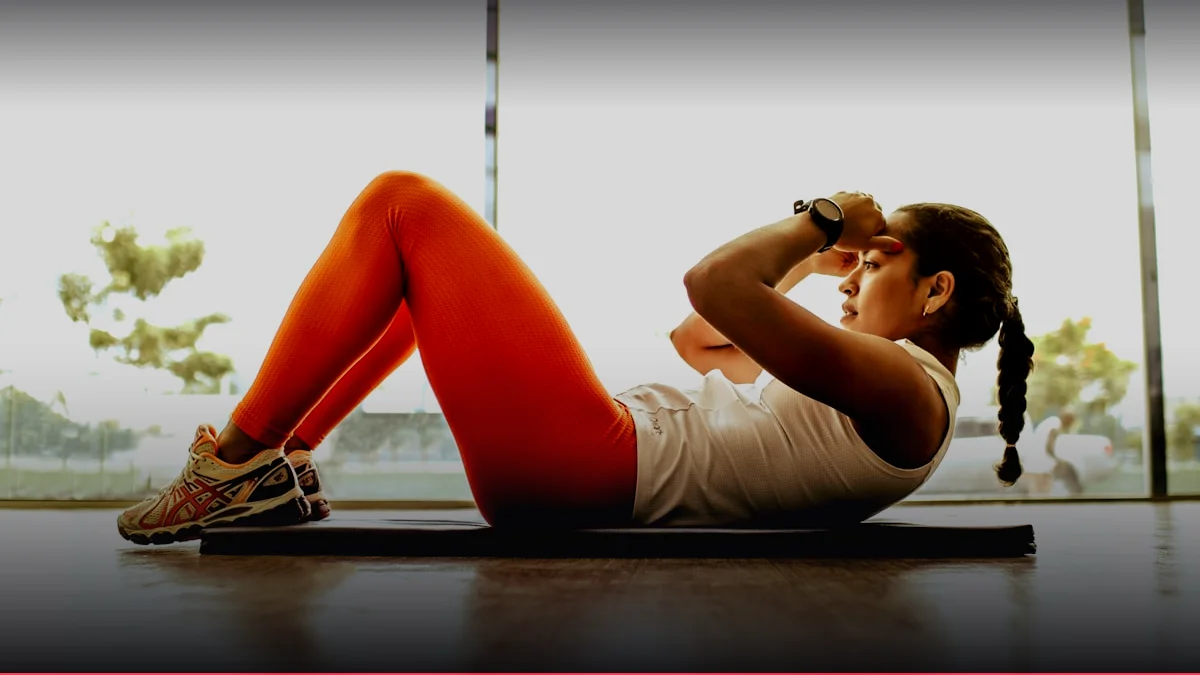
- Starting Position: Lie on your back, bend your legs at the knees, feet on the floor. Keep your hands by your temples (do not lock them behind your head). Lower back pressed to the floor.
- Flexion: On an exhale, lift your shoulder blades off the floor, simultaneously rotating the torso to the side.
- The Twist: Aim to touch your right elbow to your left knee (or simply get them as close as possible). Feel the contraction in the side part of the belly.
- Peak Contraction: Hold at the top for 0.5-1 second, maximally contracting the oblique muscles.
- Return: On an inhale, smoothly return to the starting position. Do not lower the shoulder blades completely to the floor to maintain tension throughout the set.
| Parameter | Recommended Value | Effect |
|---|---|---|
| Repetitions | 15-25 per side | Metabolic stress and separation |
| Sets | 3-4 | Optimal volume for detail |
| Tempo | 2-1-2 (Up-Pause-Down) | Control and time under tension |
| Rest | 45 seconds | Maintaining high intensity |
6. Load Progression and Integration
In twisting crunches, progression should be qualitative. Higher repetition counts and shorter rest periods are your primary tools.
- Increasing Repetitions: Aim to perform 30 perfect repetitions per side before adding weight.
- Using Resistance: Hold a small medicine ball or a 1-2 kg dumbbell. This will sharply increase mechanical tension in the oblique muscles.
- Leg Position Variation: Lift your legs off the floor at a 90-degree angle. This complicates pelvic stabilization and increases the load on the lower abs.
- "Bicycle" Exercise: This is an advanced version of twisting crunches where the legs move simultaneously with the torso, creating a dynamic load on the entire core.
Important: Twisting crunches are best placed in the middle or at the end of an ab workout. They pair perfectly with leg raises (lower abs focus) and the plank (statics). 2-3 times per week is plenty for progress.
Your abs grow not from quantity, but from the quality of every crunch. Feel your muscles working like a wound-up mechanism.
7. Analysis of Scientific Research and Evidence Base
EMG studies confirm that twisting crunches activate the external obliques 40-50% more strongly than classic straight crunches. This scientifically grounds their status as one of the best exercises for the side part of the abs.
Scientific papers on spinal health indicate that rotation in the thoracic region with a fixed lower back is safe and even beneficial for spinal mobility. However, scientists warn against performing twists with heavy weights while standing, as this creates a dangerous shear load on the discs. Lying crunches are a significantly safer option.
It was also proven that the activation of the transverse abdominis during twists improves pelvic floor control and helps stabilize the pelvis during walking and running.
8. Synergy: Nutrition, Nutraceuticals, and Recovery
For your obliques to become visible, you need not just technique, but a low body fat percentage and quality support.
- Citrulline Malate
- Improves circulation in the abdominal area, promoting better pumping and nutrient delivery to the ab muscles.
- Beta-Alanine
- Helps withstand high repetition counts, delaying the onset of fatigue ("the burn").
- L-Carnitine
- Supports fat metabolism, which is important for showing ab definition while in a calorie deficit.
- Magnesium
- Prevents cramps in the oblique muscles that may occur after intense training.
Recovery after an ab workout should include spinal mobility exercises (Cat-Cow pose) and a light stretch of the body's side lines. Quality sleep is critical for muscle fiber regeneration and maintaining the hormonal balance needed for fat burning.
9. Common Mistakes, Myths, and Injury Prevention
The main mistake is pulling yourself by the neck. This leads to overstrain of the cervical vertebrae and deactivates the abs. HANDS SHOULD ONLY TOUCH THE TEMPLES!
- Myth: Twists will make the waist wide. (Reality: The exercise without heavy weights makes the waist tight and narrow due to muscle tone).
- Mistake: Too fast execution. Inertia steals your load. Every twist must be conscious.
- Myth: This exercise burns fat on the sides. (Reality: Fat is burned through a calorie deficit; the exercise only builds the muscle beneath the fat).
- Mistake: Lifting the lower back off the floor. This shifts the load to the hip flexors and creates danger for the back.
To prevent injury, always keep the belly pulled in (activate the transverse abdominis). If you feel sharp pain in the back—stop and check your technique.
Interactive Apps & Calculators for Article
Empirical mathematical algorithms and scientific formulas for sports optimization
 Health & Rehabilitation
Tennis Elbow ECRB Tendon Load & Tyler Twist Rehab
Quantify extensor carpi radialis brevis tendon strain and calculate Tyler Twist eccentric rehabilitation dosing.
 Strength & Hypertrophy
1RM & Bench Press Calculator
Calculate your One-Rep Max using 7 scientific formulas, percentage table (50-95%), and barbell plate loader visualizer.
10. FAQ: Answers to Common Questions
- Can I do twisting crunches every day?
- The abs recover quickly, but it's easy to overtrain the obliques. 3 times per week is the ideal frequency.
- Why do I feel my neck rather than my abs?
- You are pressing your chin to your chest too hard or pulling your head with your hands. Try looking at the ceiling while lifting.
- Which is better: lying crunches or sitting twists (Russian Twist)?
- Lying crunches are safer for the lower back. The Russian Twist is harder and puts more load on the stabilizers.
- Does this exercise help with lower back pain?
- Yes, strengthening the oblique muscles creates a muscle corset that supports the spine during rotations in daily life.
- What is the optimal number of repetitions for a beginner?
- Start with 10-12 repetitions per side, focusing exclusively on movement quality.
Twisting crunches are your tool for creating a perfect athletic set of abs. Be technical, be consistent, and your results in the form of a powerful and defined core will not be long in coming.