


Seated Bent-Over Lateral Raises: Isolated Perfection for the Rear Deltoid
1. Introduction and Relevance
In the pursuit of perfectly developed shoulders, athletes often face the problem of a lagging rear deltoid bundle. This zone is the most difficult to activate because the large back muscles constantly attempt to take over the load. **Seated Bent-Over Lateral Raises** (Seated Rear Delt Raise) are a specialized variation of raises that provide the highest level of rear delt isolation by eliminating assistance from the legs and torso. This is an exercise of precision that transforms your shoulders into voluminous 3D structures, adding the necessary depth and separation.
The relevance of seated raises in modern training is driven by the need for strict technical discipline. Unlike the standing version, where an athlete often uses momentum ("cheating"), the seated position forces only the target muscles to work. This is critical for correcting imbalances in the shoulder girdle caused by the dominance of the front deltoid during presses. Furthermore, this exercise is safer for the lower back, making it ideal for athletes with limitations in heavy pulls.
In this article, we will examine the biomechanical nuances of seated raises, learn how to use the torso incline angle for a direct hit on the muscle, and discover how to structure the training process so the rear deltoid stops being your weak link, lending your posture confidence and athleticism.
2. History and Evolution
Seated bent-over lateral raises appeared as a response to professional bodybuilders' need for deeper separation of the shoulder girdle muscles. In the "Golden Era" of the 70s, athletes spent hours honing the details of their physique. Legends like Frank Zane popularized seated versions of isolating exercises, believing that only complete torso immobility allows one to "switch off" momentum and force small muscle groups to work at their limit.
The evolution of the exercise led to an understanding of the importance of hand positioning and range of motion. In the 80s and 90s, athletes began experimenting with the "pinkies up" grip and using incline benches for chest support, which further increased isolation efficiency. The exercise transformed from simple "arm waving" into a scientifically grounded method for shoulder shape correction, becoming mandatory in competition preparation.
Today, seated bent-over raises are considered the gold standard for rear deltoid development. Modern sports science has confirmed that the seated position provides the scapular stability necessary to activate rear bundle fibers without overloading the upper trapezius. The exercise has traveled the path from an auxiliary movement to one of the most important tools for sports aesthetics and shoulder health.
3. Anatomy and Biomechanics of Seated Horizontal Abduction
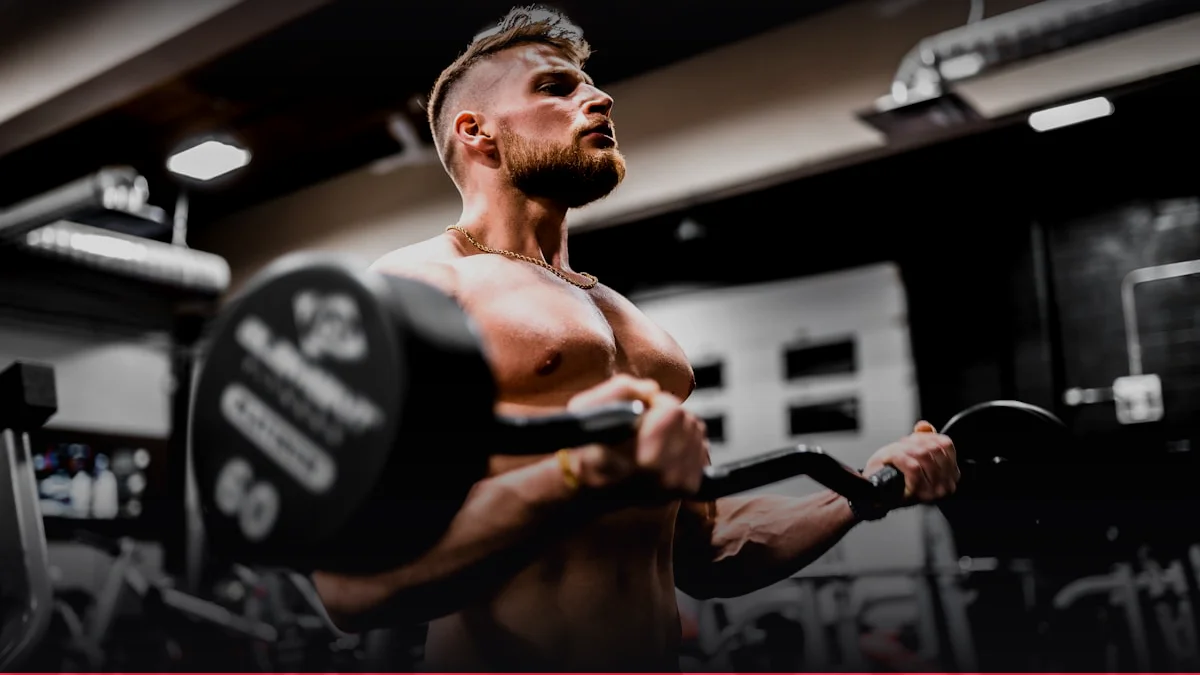
Seated raises allow all the load to be concentrated on the small muscles of the posterior shoulder surface.
- Rear Deltoid (pars spinalis)
- The primary target muscle. Responsible for horizontal shoulder abduction. The seated position allows it to be kept under constant tension.
- Infraspinatus and Teres Minor
- Rotator cuff muscles that work in synergy with the deltoid, ensuring joint stability during backward arm movement.
- Rhomboid Muscles
- Their role in this exercise should be minimal. we aim to spread the arms out to the sides, not to bring the shoulder blades together.
- Middle Trapezius
- Works as an upper back stabilizer, holding the shoulder blades in the correct position during the raise.
Biomechanical Mechanics: Biomechanically, the exercise is shoulder abduction in the horizontal plane. The main advantage of the seated position is pelvic fixation. This removes the possibility of "tossing" the weight via the legs and lower back. Furthermore, leaning the torso forward until the chest nearly touches the thighs creates the ideal angle for the dumbbells' force vector to align with the direction of the rear deltoid fibers.
4. Biochemical Impact: Occlusion and Rear Delt Pumping
Seated raises are typically performed in a 15-25 repetition range. Such high-repetition training with light weight causes an intense blood influx and occlusion (restriction of outflow) in the rear deltoid.
Biochemically, this state leads to the accumulation of growth metabolites such as lactate and hydrogen ions. The resulting metabolic stress is a signal for protein synthesis and the strengthening of the muscle's capillary network. The pump you feel after a set not only visually increases the shoulder but also promotes fascial expansion, which is a necessary condition for further hypertrophy. Since the rear deltoid is often ignored, such an intense influx of nutrients provides a powerful boost for its growth.
Seated raises are precision work. You must feel the burn specifically in the rear of the shoulder, not in the neck or back.
It is also important to mention the impact on the CNS. The need to control a perfect trajectory with complete torso immobility improves neuromuscular conductivity. The brain learns to better recruit rear deltoid fibers, which subsequently improves results in all pulling exercises for the back.
1RM & Bench Press Calculator
Calculate your One-Rep Max using 7 scientific formulas, percentage table (50-95%), and barbell plate loader visualizer.
Launch Tool5. Practical Methodology and Execution Technique
Seated raise technique does not forgive momentum. Any jerky movement shifts the load to the traps.
- Starting Position: Sit on the edge of a bench, place feet together. Lean forward so your stomach nearly touches your thighs. Hold dumbbells under your legs, palms facing each other.
- Shoulder Blades: This is critical. Spread the shoulder blades and keep them stable. Do not try to bring them together while lifting the arms—this will engage the back.
- The Raise: On an exhale, lift the dumbbells out to the sides. Elbows should be slightly bent and pointed up and out. The movement should resemble the flapping of wings.
- Range of Motion: Lift the dumbbells to shoulder level. Do not try to bring them too high, to avoid joint injury.
- Return: On an inhale, smoothly lower the dumbbells. Do not allow them to touch each other at the bottom, to maintain constant tension in the delts.
| Parameter | Recommended Value | Effect |
|---|---|---|
| Repetitions | 15-25 | Metabolic stress and separation |
| Sets | 4-5 | High volume for definition detail |
| Tempo | 2-1-2 (Up-Pause-Down) | Control and peak contraction |
| Rest | 45 seconds | Maintaining high pump levels |
6. Load Progression and Integration
In seated raises, progression via weight is secondary. The main goal is improving control and increasing time under tension.
- Adding Repetitions: Aim to perform 25 perfect repetitions before taking dumbbells 1 kg heavier.
- Isometric Pauses: Hold the dumbbells at the top for 2-3 seconds during every repetition. This will remove any momentum and "explode" your delts.
- Drop Sets: Perform 15 repetitions, immediately take lighter dumbbells and do another 15. This is the best way to reach complete rear delt failure.
- Supersets: Pair seated raises with seated dumbbell presses for comprehensive work on the entire shoulder girdle.
Important: Seated bent-over raises are best placed as a finisher in a shoulder or back workout. It is the ideal exercise to "finish off" the rear deltoid after heavy rows when the back is already fatigued and cannot take over the load.
The rear deltoid loves volume. Don't be afraid of many sets; be afraid of losing the feel of the muscle.
7. Analysis of Scientific Research and Evidence Base
EMG (electromyography) studies confirm that seated bent-over raises provide 20-25% higher rear deltoid activation compared to the standing version. This is explained by the elimination of parasitic torso movements that inevitably arise when working with dumbbells while standing.
Scientific papers on shoulder joint health indicate that the rear deltoid is a key antagonist to the front deltoid. Its development is necessary to prevent "internal rotation" of the shoulder, which leads to impingement syndrome. Strengthening the rear deltoid with seated raises makes your shoulders not only more beautiful but also significantly more resilient to injury.
Scientists also investigated the role of the grip. It was proven that a grip with pinkies rotated upward (pronation) activates the outer part of the rear deltoid slightly more strongly, while a neutral grip distributes the load more evenly between the deltoid and the rotator cuff muscles.
8. Synergy: Nutrition, Nutraceuticals, and Recovery
Growing small muscle groups like the rear deltoid requires quality microcirculation and nutrient support.
- Citrulline Malate
- Critically important for pumping. Improves oxygen delivery to the delts, allowing you to train longer in the burn zone.
- Beta-Alanine
- Helps fight acidification in high-rep sessions, allowing for those 5 final repetitions.
- Glucosamine + Collagen
- Support shoulder joint health, which carries the primary load during arm abduction.
- Magnesium
- Necessary for relaxing the neck and trap muscles, which often overstrain during raises.
Recovery after raises should include work on scapular mobility and stretching the chest muscles. Chest tightness often prevents correct backward arm abduction, forcing the back to engage prematurely. Using SMR (massage ball) for the rear deltoid and infraspinatus zone will help remove trigger points and improve blood circulation.
9. Common Mistakes, Myths, and Injury Prevention
The main mistake is "cheating" with the head and shoulders. When you toss the dumbbells by a jerky upward shoulder movement, you are training the trap, not the deltoid. MOVEMENT MUST BE STRICTLY CONTROLLED!
- Myth: You need heavy weights for rear deltoid growth. (Reality: The rear deltoid is a small muscle; it grows from ideal technique and pumping).
- Mistake: Retracting the shoulder blades at the top. This shifts the load to the rhomboid muscles. Try to keep the shoulder blades spread.
- Myth: This exercise is harmful to the back. (Reality: The seated position with chest supported by the thighs makes it safe for the lower back).
- Mistake: Too fast a lowering tempo. Control the negative phase every second.
To prevent injury, always start with a thorough warm-up. Do not try to bring the arms too far back—this creates dangerous tension in the anterior shoulder capsule.
Interactive Apps & Calculators for Article
Empirical mathematical algorithms and scientific formulas for sports optimization
 Strength & Hypertrophy
VBT Velocity Based Training
Determine % 1RM and target strength zones from mean barbell velocity (m/s).
 Strength & Hypertrophy
Squat 1RM & Depth Calculator
Calculate your Squat One-Rep Max using 5 formulas, percentage breakdown, and biomechanical depth angles.
10. FAQ: Answers to Common Questions
- Can I do seated raises with chest support on an incline bench?
- Yes, this is one of the best options. The bench completely fixes your torso, excluding any assistance from the back.
- Why do I only feel my neck during the exercise?
- Likely, you are lifting your shoulders too high toward your ears. Try lowering the shoulders and focusing on spreading the elbows out to the sides.
- What is better: dumbbells or cable for the seated rear deltoid?
- Both exercises are good. Dumbbells give peak tension at the top; cable gives constant tension throughout the range.
- Will this exercise help fix a "rounded" back?
- Absolutely. Strengthening the rear deltoid is the first step toward correcting posture and opening the shoulders.
- How many times per week can I train the rear deltoid?
- Since it's a small muscle, 2-3 times per week for 4-5 sets is ideal for accelerated growth.
Seated bent-over lateral raises are your path to ideal shoulder shape. Be technical, be patient, and your results in the form of powerful rear deltoids will surprise even yourself.