

Front Squats: The Royal Exercise for the Quads and an Athlete's Steel Core
1. Introduction and Fundamental Relevance for Modern Strength Athletes
In the complex and oversaturated world of modern strength training, few exercises can match the complexity, technicality, and effectiveness of the **Front Squat**. While the classic back squat is rightfully considered the "king" of exercises for overall body mass, the front squat is a true surgical tool for building powerful quadriceps and an incredibly strong muscular core. The primary difference lies in the specific positioning of the load: the barbell is placed in front, on the deltoid muscles, radically changing the entire biomechanics of the movement and the distribution of the load.
The relevance of front squats in modern training is driven not only by aesthetic goals but also by functionality. It is a foundational element of weightlifting, CrossFit, and the conditioning preparation for athletes across many sports. The exercise requires high joint mobility, perfect posture, and iron grit. It practically eliminates the possibility of "slacking" or cheating—if you lean forward too much, the barbell simply falls. This makes the front squat one of the most honest and safest exercises for the spine when performed correctly, as it forces the athlete to maintain a vertical position.
The front squat is not just a leg exercise; it is a hormonal explosion that forces your entire body to become stronger, more resilient, and more functional.
2. History and Evolution: From the Roots of Weightlifting to the "Golden Era"
The history of the front squat is inextricably linked to the emergence of weightlifting as an Olympic sport. In the early 20th century, when athletes began actively performing the clean, the front squat became a necessary element for successfully completing the lift. Legends such as Yury Vlasov and Vasily Alekseyev used this exercise as the fundamental basis for their incredible strength and stability.
The evolution of the exercise has gone from an auxiliary movement for weightlifters to an independent discipline in bodybuilding. In the 60s and 70s, "Golden Era" athletes, including Arnold Schwarzenegger, Tom Platz, and Frank Zane, actively integrated front squats into their programs to create depth and separation in the quadriceps. They understood that the front-loaded position allowed them to keep their backs more vertical, shifting the load emphasis from the back directly to the anterior surface of the thigh. Today, front squats are experiencing a new peak in popularity thanks to the rise of CrossFit and functional training.
3. Anatomy and Biomechanics of Front Loading: A Deep Load Analysis
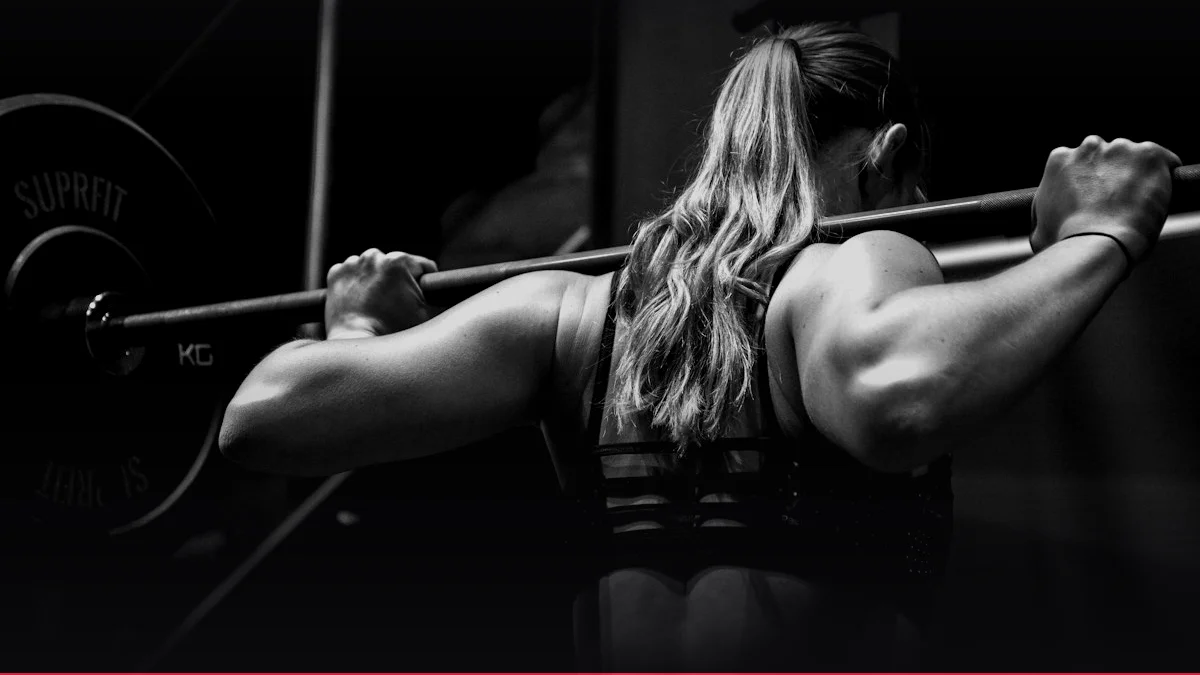
The front squat is a unique movement where gravity works in synergy with the athlete's vertical body structure. - **Quadriceps (Four-headed Thigh Muscle):** The primary target muscle. Due to the vertical torso position, the knee travels forward significantly more than in a back squat, creating maximum tension in all four quadriceps heads, especially the vastus lateralis and vastus medialis ("teardrop"). - **Core Muscles (Abs and Spinal Extensors):** Work in an extreme isometric mode. The barbell on the chest attempts to collapse your torso forward, and you are forced to counteract this through stabilizer tension. - **Upper Back and Rhomboids:** Keep the shoulder blades and thoracic region retracted and open, preventing the elbows from dropping down. - **Gluteus Maximus:** Although it works slightly less than in the back squat, it remains a powerful synergist when standing up from the bottom of the range.
Biomechanical Mechanics: Biomechanically, the front squat is characterized by a significantly lower torque at the hip joint and higher at the knee joint. The torso incline angle is typically 75-85 degrees, which is key to preserving intervertebral disc health and minimizing compression.
4. Biochemical Impact: Hormonal Surge and Metabolic Adaptation
Performing front squats with heavy weights triggers a powerful systemic response in the body. Working a large muscle mass in combination with high intensity (75-90% of 1RM) stimulates the endocrine system. Biochemically, this process is accompanied by a significant release of testosterone and somatotropin (growth hormone) immediately after the workout.
This is related to the activation of a colossal number of motor units and metabolic stress in the quadriceps. Furthermore, front squats lead to rapid muscle acidification with lactate, a powerful signal for protein synthesis and hypertrophy of Type II muscle fibers (fast-twitch). The exercise also requires high neuromuscular coordination, improving the brain's ability to recruit new fibers and increasing overall strength potential in all other leg exercises.
Your strength in the front squat is limited not by your legs, but by your ability to keep your back straight. Train your core as hard as your thighs.
Front Squat Quad & Thoracic Spine Load
Calculate front squat to back squat strength ratio (75-85%) and thoracic extension demands under load.
Launch Tool5. Practical Methodology and Execution Technique: Step-by-Step Movement Algorithm
Front squat technique does not forgive mistakes. The slightest deviation from verticality leads to the barbell falling. 1. **Grip and Barbell Position:** The bar should rest on the anterior delts, touching the clavicles. Use a weightlifting grip (fingers under the bar) or a cross-arm grip. 2. **Foot Stance:** Feet slightly wider than shoulders, toes slightly pointed out. This allows the pelvis to descend between the feet while maintaining vertical back alignment. 3. **Descent (Eccentric Phase):** On a deep inhale, smoothly lower yourself down. Elbows must remain pointed forward and up. 4. **Depth of the Squat:** Descend below parallel of the thighs to the floor. Full range ("to the floor") ensures maximum quadriceps activation. 5. **Ascent (Concentric Phase):** On a powerful exhale, push off the floor through your heels. The first movement should be lifting the chest and elbows upward.
| Parameter | Recommended Value | Effect |
|---|---|---|
| Repetitions | 3-8 reps | Strength and power |
| Sets | 3-5 sets | Hypertrophy and mass |
| Tempo | 3-1-1 | Joint safety |
| Rest Time | 2-3 min | CNS recovery |
6. Load Progression and Strategic Integration into the Training Plan
Progression should be gradual and based on movement quality, not just kilograms on the bar: - **Linear Progression:** Add 2-5 kg weekly as long as technique remains perfect. If elbows drop, stop. - **Pauses at the Bottom:** Perform squats with a 2-3 second pause at the bottom. This completely eliminates momentum and forces the core to work. - **Increasing Repetitions:** If you cannot add weight, try to perform 1-2 more repetitions with the same weight. - **Tempo Variations:** Eccentric squats (5-7 second descent) are a way to strengthen ligaments and prepare the body for heavier weight.
Front squats are best placed as the first exercise on leg day. They require a fresh central nervous system and high concentration.
7. Analysis of Scientific Research and Evidence Base: EMG Data and Knees
EMG (electromyography) studies confirm that front squats provide the same thigh muscle activation as back squats but with 20-25% less weight. This means you receive the same leg growth stimulus while significantly reducing the load on the spine.
Scientific papers indicate that front squats create less load on the anterior cruciate ligament (ACL) and the medial meniscus. This makes the exercise an ideal choice for athletes with a history of knee injuries. It has also been proven that front squats activate the spinal extensors in the thoracic region significantly more, which is beneficial for improving posture and preventing rounded shoulders.
8. Synergy: Nutrition, Nutraceuticals, and Athlete Recovery Strategy
Recovery after such an intensive exercise requires powerful nutrient support: - **Creatine Monohydrate:** Provides strength for heavy sets and rapid ATP recovery. - **Beta-Alanine:** Helps combat acidification in the quadriceps during long sets. - **Glucosamine and Chondroitin:** Support for knee joint cartilage is mandatory with heavy weights. - **Magnesium and Zinc:** Necessary for muscle relaxation and supporting an anabolic environment. - **MFR (Self-Massage):** Working with a roller improves blood circulation in the quadriceps after a workout.
9. Common Athlete Mistakes and Injury Prevention in Squatting
The main mistake is dropping the elbows. As soon as the elbows lower, the weight shifts forward, rounding the back and creating pressure on the lower back. ALWAYS KEEP YOUR ELBOWS HIGH! - **Heels Lifting:** Indicates poor ankle mobility. Use weightlifting shoes to compensate. - **Wrist Strain:** If wrist flexibility is low, switch to a cross-arm grip or use lifting straps. - **Knees Caving In:** Creates traumatic stress on the knee ligaments. Knees should point directly over the toes. - **Rapid Descent:** Losing control in the negative phase leads to spinal injury risk at the bottom of the squat.
Interactive Apps & Calculators for Article
Empirical mathematical algorithms and scientific formulas for sports optimization
 Strength & Hypertrophy
1RM & Bench Press Calculator
Calculate your One-Rep Max using 7 scientific formulas, percentage table (50-95%), and barbell plate loader visualizer.
 Strength & Hypertrophy
VBT Velocity Based Training
Determine % 1RM and target strength zones from mean barbell velocity (m/s).
10. FAQ: Expert Answers to Key Questions for Athletes and Beginners
- What can replace the exercise if my wrists hurt significantly?
- Try Goblet Squats with a dumbbell at the chest or use a specialized safety bar or handles.
- Can I do front squats in a Smith machine?
- It is possible for quadriceps isolation, but you lose 50% of the core and stabilizer benefits.
- Is it mandatory to go very deep?
- Yes, for full effect, you should go "to the floor" (full depth) for maximum quadriceps activation.
- Why does my upper back hurt after the exercise?
- This is normal. Your thoracic stabilizers performed a lot of work holding the heavy barbell.
- What is the optimal starting weight?
- Start with 40-50% of your back squat weight. Focus on technique and elbows.
- Can I do front squats every day for leg growth?
- No, this is a heavy exercise requiring 48-72 hours for full muscle and CNS recovery.
- Does this exercise affect glute growth in women?
- Yes, the glutes work, but significantly less than in classic back squats.
- Does the front squat help increase the deadlift result?
- Yes, a strong core and powerful quadriceps help you "break" the bar off the floor easier in the deadlift.
- What footwear is best for front squats?
- Weightlifting shoes with a hard sole and a 2-3 cm heel are the ideal choice for stability and depth.
- Can I perform the exercise with dumbbells instead of a barbell?
- Yes, this is called a Goblet Squat, and it's a great way to learn technique before moving to the bar.
- How do I avoid bar pressure on my throat?
- The bar should rest on the delts, not the soft tissues of the neck. Pull your chin back slightly.
- Can I use a bar pad?
- Not recommended, as it makes the barbell position unstable and increases the risk of slipping.
The front squat is a challenge to your strength, mobility, and will. Add this exercise to your arsenal, be technical, and your leg development results will surprise even you.