

Face Pull: The Gold Standard for Posture, Shoulder Health, and Rear Delt Peak
1. Introduction and Fundamental Relevance in Modern Fitness
In the complex world of modern fitness, where training programs are often dominated by pressing movements (bench press, overhead press) and sedentary lifestyles prevail, a serious biomechanical imbalance between the anterior and posterior parts of the shoulder girdle emerges. This inevitably leads to rounded shoulders, chronic shoulder pain, limited mobility, and postural deformation. The **Face Pull** is an exercise that has become a true savior and a "gold standard" for athletes of all levels. It is a unique multi-joint movement that combines a horizontal pull with active external shoulder rotation, making it indispensable for targeting the rear deltoid, rhomboid muscles, and rotator cuff muscles.
The relevance of the Face Pull today extends far beyond pure bodybuilding or powerlifting. It is a foundational exercise for "Prehab" (injury prevention) and shoulder girdle rehabilitation systems after old injuries. It literally allows you to "open up" the chest, strengthen the deep scapular stabilizers, and create a healthy muscular corset that keeps your posture straight throughout the workday. For those who dedicate significant time to pressing exercises, the Face Pull is a critical antagonist that prevents the development of impingement syndrome and preserves the integrity of the glenoid labrum.
The Face Pull is not just an exercise; it is your insurance policy against shoulder injuries and a guarantee of a proud, athletic posture for years to come.
2. History and Evolution: From Rehabilitation to Mainstream
The Face Pull exercise does not have a single specific inventor; it organically evolved from physical therapy methods and specific training for weightlifters. Initially, similar cable movements were used exclusively for targeted back muscle strengthening, but the emphasis on "pulling to the face" with hand separation became mass-market popular in the 90s and 2000s thanks to the work of famous coaches like Jeff Cavaliere (Athlean-X), who made the Face Pull a mandatory element of nearly every workout.
The evolution of the exercise has gone through a complex path from simple high-weight strength pulls (which often turned it into an ineffective analog of a chest pull) to the understanding of the critical importance of external rotation at the end point. The modern scientific approach focuses not on the weight itself, but on the position of the thumbs and perfect scapular fixation. We have learned to use the rope attachment to pull its ends as far apart as possible, which significantly increased the level of EMG activation in the target muscle fibers. Today, the Face Pull is viewed as one of the most functional upper-body exercises used in the preparation of elite professional athletes.
3. Anatomy and Biomechanics: External Rotation and W-Shaped Contraction
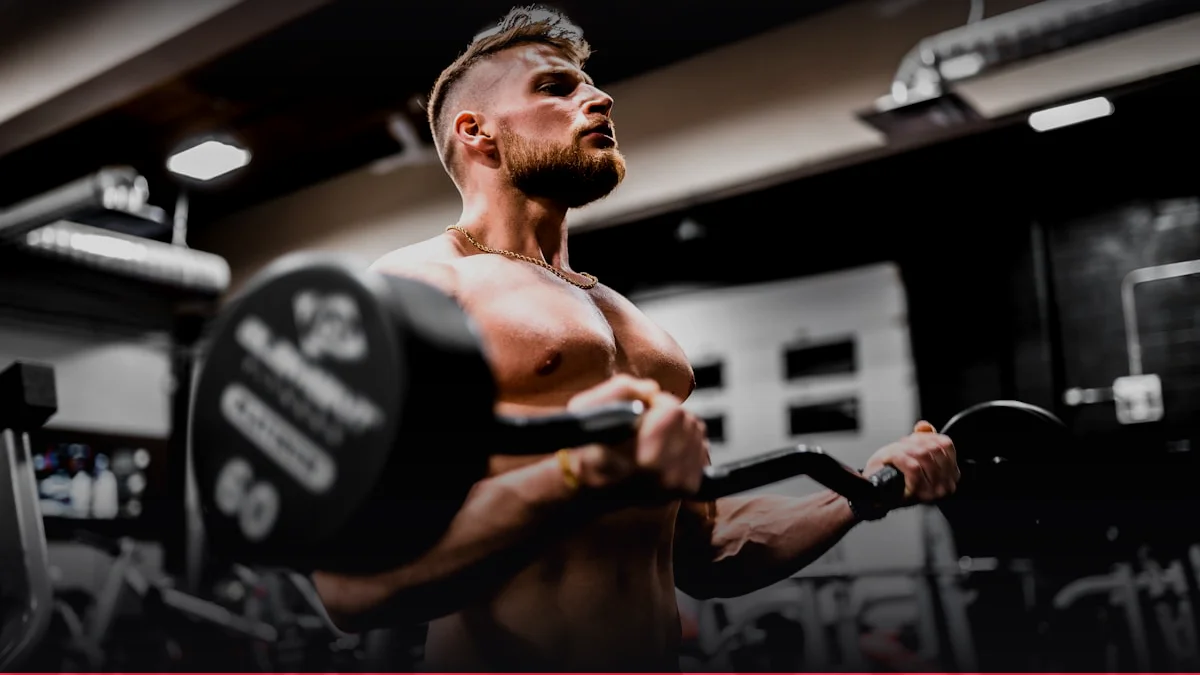
The Face Pull is a complex-coordination exercise that engages a whole group of posterior chain upper-body muscles that often remain weak and underdeveloped. - **Rear Deltoid (Posterior Deltoid):** The primary target muscle. Performs horizontal shoulder abduction. The Face Pull ensures maximum tension through a long and physiological trajectory. - **Infraspinatus and Teres Minor:** Critically important parts of the rotator cuff. They are responsible for external shoulder rotation (turning the wrists back). Strengthening these muscles is the key to joint stability. - **Middle and Lower Trapezius:** Retract and depress the shoulder blades toward the spine, providing a stable platform for powerful arm movement. - **Rhomboids:** Work in synergy with the traps to create detail and thickness in the interscapular zone.
Biomechanical Mechanics: Biomechanically, the Face Pull combines a horizontal pull (pulling the block toward yourself) with active external rotation (spreading the arms into a "W" shape). This forces the scapula to go through a full and healthy movement cycle: retraction to the center and upward rotation. This combination is the most physiological way to strengthen the muscular corset that keeps the humerus in the correct position within the glenoid cavity.
4. Biochemical Impact: Neuromuscular Control and Neuroplasticity
The primary biochemical and physiological effect of the Face Pull is based on improving the mind-muscle connection and proprioception. The rear deltoid and rotator muscles are often "dormant" or inhibited in people with sedentary jobs. Performing this exercise in a high-repetition range (15-25 reps) forces the nervous system to create new neural pathways to control these small but important structures.
From a metabolism perspective, the Face Pull creates a high level of pumping in the posterior shoulder girdle. This significantly improves tissue capillarization, which is important for removing metabolic waste products after heavy pressing sessions. The accumulation of lactate in the area between the shoulder blades stimulates collagen synthesis in the tendons, strengthening the entire shoulder apparatus.
The Face Pull is the hygiene of your body. You should do it as regularly as you brush your teeth to keep your joints functional for decades.
Face Pull Rear Delt & Rotator Cuff Balance
Calculate Face Pull to bench press balancing ratio (20-25%), rope eye-height angle, and infraspinatus activation.
Launch Tool5. Practical Methodology: "Gold Standard" Execution Technique
For the Face Pull to yield results rather than just fatiguing the biceps, a strict execution algorithm must be followed. 1. **Setup:** Set the pulley at eye level or slightly higher. Use only a long rope attachment. 2. **Grip:** Take the ends of the rope with a neutral grip (thumbs facing you). This allows for rotation at the end of the movement. 3. **The Pull:** Pull the rope toward your face (at forehead level), simultaneously pulling the ends of the rope apart. 4. **Elbow Emphasis:** Your elbows must always stay higher than or at the same level as your wrists. Do not let them drop down! 5. **Peak Fixation:** At the end point, your thumbs should be pointing backward. Hold this position for 2 seconds, maximally squeezing the muscles between your shoulder blades.
6. Load Progression and Integration into the Training Macrocycle
In the Face Pull, we NEVER progress with weight at the cost of technique. If the weight is too heavy, you will inevitably start pulling with your whole body (cheating), turning off the rear delts. - **Increasing Isometric Pause:** Work up to a 5-second peak hold. This forces your stabilizers to adapt to prolonged loading. - **Slowing the Negative Phase:** Return your arms to the starting position over 4-5 seconds. This improves scapular control. - **Increasing Volume:** The Face Pull is an exercise that can and should be done frequently. 3-4 sets of 20 reps at the end of every upper-body workout is an ideal strategy.
7. Analysis of Scientific Research: Evidence Base and Posture
EMG studies confirm that the Face Pull is one of the best exercises for simultaneous complex activation of the rear deltoid and infraspinatus. Scientific papers in the field of "Postural Restoration" indicate that the Face Pull helps reduce chronic activity in the upper trapezius (which is often overstressed) and increases the tone of the lower trapezius. This is critical for people with "tech neck" syndrome and frequent tension headaches. It has also been proven that regular performance of the exercise improves shoulder stability during Olympic snatches and cleans.
8. Synergy: Nutrition, Nutrients for Ligaments, and Recovery
To support rotator cuff health and rapid recovery after loading, it is recommended: - **Collagen + Vitamin C:** The foundation for connective tissue regeneration, which bears the main load in this exercise. - **Omega-3:** A powerful anti-inflammatory factor for shoulder tendons. - **Magnesium:** Helps relax the neck and upper trapezius muscles after intense pulls. - **Citrulline:** Improves microcirculation in the rear deltoid, accelerating its hypertrophy.
9. Common Mistakes, Myths, and Injury Prevention
- Pulling with Biceps: If you just bend your arms at the elbows, you aren't training your shoulders. The movement must start with the spreading of the elbows and shoulder blades.
- Body Lunging: Stand still. If you are being pulled forward, reduce the weight on the pulley.
- Too Narrow Grip: Do not use narrow attachments. Only a long rope allows for full external rotation.
- Protruding the Chin: Keep your head level; do not try to "bite" the rope.
Interactive Apps & Calculators for Article
Empirical mathematical algorithms and scientific formulas for sports optimization
 Health & Rehabilitation
Behind-the-Neck Pulldown Safety & Impingement
Assess extreme glenohumeral external rotation, horizontal abduction stress, and C6-C7 compression risk.
 Strength & Hypertrophy
Dumbbell Pullover: Latissimus vs Pectoral Torque
Calculate torque curves between latissimus dorsi and sternal pectoralis across 90° to 180° shoulder flexion.
10. FAQ: Expert Answers to Key Athlete Questions
- Can I do Face Pulls with a resistance band at home?
- Yes, it is one of the best options. The band provides progressive resistance, which is maximal at the point of peak contraction, ideal for this exercise.
- Why do I only feel my forearms and biceps?
- You are not pulling your hands apart. Your wrists at the end should be far from each other, forming a wide "W" shape.
- Does the Face Pull replace classic bent-over lateral raises?
- No, they complement each other perfectly. Raises are delt isolation; Face Pulls are for the health of the entire shoulder joint.
- Can I do Face Pulls every day to fix my posture?
- With moderate load, yes. This is a great way to combat the negative effects of sedentary computer work.
- What pulley height is most effective?
- Eye or forehead level. This allows you to pull the weight at an angle that maximizes lower trapezius and rotator work.
- Does the Face Pull help increase the bench press?
- Yes, by creating a stable base on the back and preventing injuries, allowing you to train harder and longer.
- What if something clicks in my shoulder during the exercise?
- Try changing the pulley height or the elbow spread angle. If pain persists, consult a specialist.
- Is it worth using heavy weight for rear delt mass?
- Only if your technique remains perfect. It's better to do 20 clean reps than 5 with cheating.
- Which grip is better: thumbs facing forward or backward?
- The grip where the thumbs point backward at the end is better—it guarantees maximum rotation.
- Can I do Face Pulls with one arm?
- You can for correcting asymmetry, but the classic two-handed version is better for scapular stabilization.
- How long until I see changes in my posture?
- The first feelings of "opened" shoulders appear within 2-3 weeks of regular performance.
- Does this exercise help with neck pain?
- Yes, as it strengthens the muscles that take the load off the upper trapezius and cervical spine.
- Can I use rings for Face Pulls?
- Yes, it's a great bodyweight option. The lower you lower your torso, the harder the exercise becomes.
- What tempo is best for rear delt hypertrophy?
- A calm, controlled tempo with a mandatory pause at the moment of maximum tension.
- Can I do Face Pulls before a bench press?
- Yes, as part of a warm-up to "activate" the shoulder girdle and stabilize the joints before heavy loading.
- Does the Face Pull affect bicep development?
- The bicep works as a synergist during elbow flexion, but its role should be minimal. The main load should remain on the delts and back.
The Face Pull is your long-term investment in body health and beauty. Make this exercise a mandatory part of your routine, and you will forget about shoulder pain, gaining perfect posture and powerful shoulders instead.