

One-Arm Dumbbell Row: Maximum Range of Motion for Back Thickness
1. Introduction and Relevance
Among the vast arsenal of back development exercises, few can compare in effectiveness with the **One-Arm Dumbbell Row**. This is a compound, multi-joint exercise that not only allows for working with heavy weights but also achieves a range of motion impossible with a barbell. By working each arm independently, the athlete can maximally stretch the latissimus dorsi at the bottom and achieve peak contraction at the top.
The relevance of the dumbbell row in modern bodybuilding and functional training is driven by its ability to correct asymmetries. Since the right and left sides of the back work independently, situations where the stronger side takes over the load are eliminated. This makes the exercise indispensable for building a proportional and "deep" muscle mass. Furthermore, the dumbbell row is significantly safer for the lower back than the bent-over barbell row, thanks to the support provided by the free hand.
In this article, we will examine the biomechanical secrets of this movement in detail, learn how to exclude the biceps from the work for maximum back load, and discover how to structure training so your back looks powerful and detailed from any angle.
2. History and Evolution
The bent-over dumbbell row has been an integral part of athlete training since the early 20th century. However, it gained true fame in the 70s when "Golden Era" athletes began using it to create back "thickness." The legendary Franco Columbu, who possessed one of the most detailed backs in history, considered the dumbbell row a mandatory exercise for upper back muscle separation.
The evolution of the exercise led to an understanding of the importance of torso position and incline angle. While athletes in the past often performed the row with significant body swaying (cheating), modern methodology leans toward strict stabilization and a slow tempo. In the 80s, variations performed face-down on an incline bench emerged, allowing for complete back isolation and removing load from the legs.
Today, the one-arm dumbbell row is viewed not only as a mass-building exercise but also as a tool for functional rehabilitation. It helps strengthen the scapular stabilizer muscles and improve posture, which is critical for individuals with sedentary jobs. The exercise has traveled the path from a raw strength movement to a high-precision tool of sports physiology.
3. Anatomy and Biomechanics of the Horizontal Row
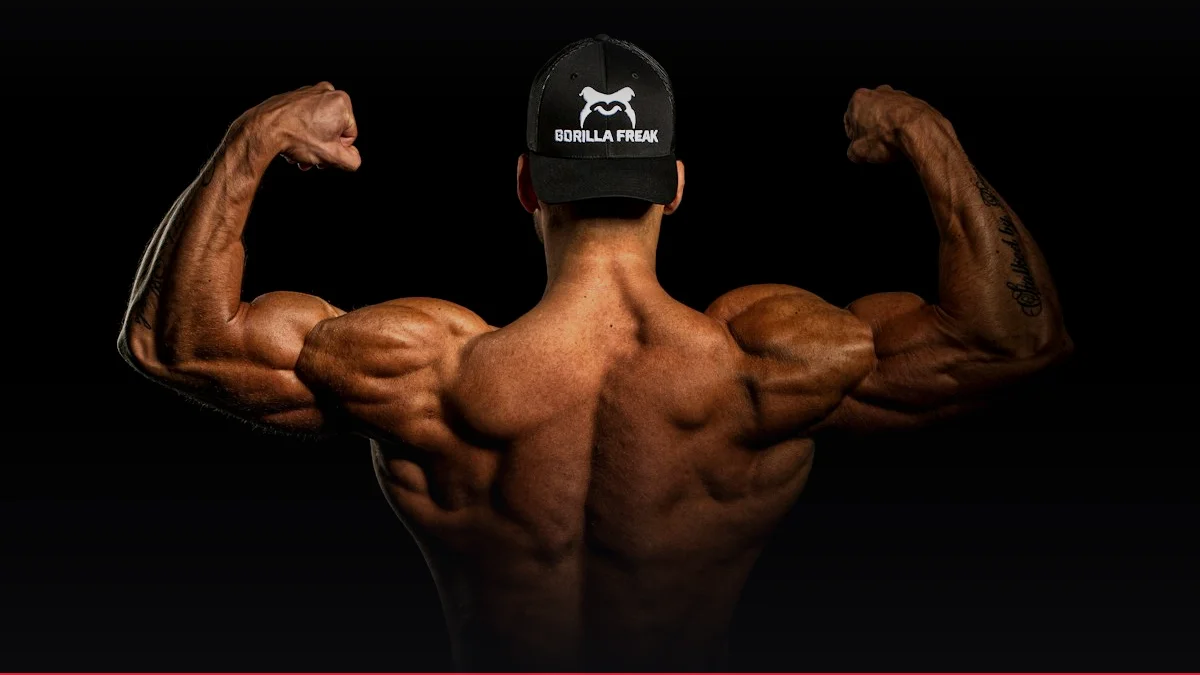
The dumbbell row engages a massive array of muscles, each playing its role in forming a powerful torso.
- Latissimus Dorsi (Lats)
- The primary target muscle. Responsible for shoulder adduction. The large range of the dumbbell allows for engaging it along the entire length of the fibers.
- Rhomboids and Middle Trapezius
- Engaged at the top point when retracting the scapula toward the spine, creating back "thickness."
- Teres Major and Infraspinatus
- Assist in shoulder joint stabilization and add volume to the upper back.
- Rear Deltoid
- Acts as a synergist, helping to pull the elbow back.
- Biceps and Brachialis
- Perform elbow flexion. Our task is to minimize their role through the "elbow pull" technique.
Biomechanical Mechanics: Biomechanically, the movement is a combination of shoulder extension and scapular retraction. Since the arm with the dumbbell is not restricted by a bar, we can bring the elbow significantly higher than the level of the back, ensuring peak muscle contraction impossible in barbell rows. Additionally, supporting the free hand and knee creates a stable triangle that relieves the spinal extensors.
4. Biochemical Impact: Anabolic Response of the Lats
The one-arm dumbbell row is an exercise that allows for working with extremely heavy weights (athletes often use 50-60 kg dumbbells or more). This creates a powerful mechanical stimulus for activating the mTOR signaling pathway, the primary driver of hypertrophy.
Biochemically, working in an 8-12 repetition range leads to significant metabolic stress. Since the latissimus dorsi has a large area and mixed fiber types, they actively accumulate glycogen and lactate. This causes blood flow and expansion of the capillary network (angiogenesis), visually increasing muscle volume through the sarcoplasmic component.
The dumbbell row is an exercise that makes your back "breathe." You must feel the muscle stretch and fill with power with every repetition.
It is also important to mention the hormonal response. Heavy compound rows stimulate the secretion of testosterone and insulin-like growth factor (IGF-1), especially if performed with high intensity and short rest periods between sets. This creates an anabolic background for whole-body growth.
Seated Cable Row Grip Width & Lat Isolation
Compare narrow neutral grip (latissimus dorsi focus) vs wide pronated grip (rhomboids and mid-traps EMG).
Launch Tool5. Practical Methodology and Execution Technique
To ensure the load goes into the back rather than the biceps, technique must be flawless.
- Starting Position: Place one knee and the corresponding hand on a bench. The other foot stands on the floor, slightly back and to the side. The back should be parallel to the floor or at a slight upward incline.
- Beginning the Movement: Grab the dumbbell. At the bottom, fully drop the shoulder, feeling the stretch in the lat.
- The Row: On an exhale, begin pulling the dumbbell toward the hip (not the chest!). Imagine you are pulling with your elbow, and your hand is merely a hook.
- Peak Contraction: At the top, bring the elbow above the level of the back and maximally retract the scapula toward the center. Hold for 1 second.
- Return: Slowly and controlledly lower the dumbbell, relaxing the scapula but not losing muscle tension.
| Parameter | Recommended Value | Effect |
|---|---|---|
| Repetitions | 8-12 | Myofibrillar hypertrophy and strength |
| Tempo (Eccentric) | 3 seconds | Maximum fiber micro-trauma |
| Sets | 3-4 per arm | Optimal volume for growth |
| Grip | Neutral (palm toward the bench) | Most natural angle for the shoulder |
6. Load Progression and Integration
In this exercise, progression should be constant. You can add weight to the dumbbell every 2-3 weeks. However, when the weight becomes very heavy, be sure to use lifting straps so that grip does not become the limiting factor.
- Increasing the Pause: Try a 3-second pause at the top. This is incredibly difficult but will force your back to grow faster.
- Drop Sets: After completing the main set, take a dumbbell 30% lighter and perform another 10 reps without rest.
- Stretch Pauses: Hold at the bottom for 2 seconds, allowing the dumbbell weight to maximally stretch the latissimus fascia.
- Deficit Work: Stand on a small platform with your foot to increase the range of the dumbbell descent below the bench level.
Important: The one-arm dumbbell row is ideal for both the beginning of a back workout (if you want to work for strength) and the middle for detailing. It pairs excellently with pull-ups or lat pulldowns, providing loading in different planes.
Your back is only as strong as your control over the weight in this exercise.
7. Analysis of Scientific Research and Evidence Base
EMG (electromyography) studies confirm that the one-arm dumbbell row provides 15-20% higher activation of the lower latissimus dorsi compared to the bent-over barbell row. This is explained by the ability to shift the pull vector toward the hip, matching the fiber direction of the lat.
Scientific papers on spinal stability indicate that unilateral rows create significant anti-rotational loading on the core muscles. This means that while you train your back, your abs and obliques are working in overdrive to prevent your torso from twisting.
Scientists have also proven that using bench support reduces the compressive load on the lumbar intervertebral discs by 40% compared to unsupported barbell rows. This makes the dumbbell row the number one choice for athletes with herniations or protrusions in the lower back.
8. Synergy: Nutrition, Nutraceuticals, and Recovery
Growing Massive Back Muscles: Growing massive back muscles requires powerful nutrient support. The traps and lats need plenty of amino acids to recover after heavy strength sessions.
- Creatine Monohydrate
- Provides strength for working with heavy dumbbells, which is critical for load progression.
- Citrulline Malate
- Improves back capillarization, providing the fascia-stretching pump.
- B Vitamins
- Necessary for CNS recovery, which is fatigued by the coordination required for unilateral work.
- Protein (2-2.5 g/kg)
- The foundation for building new myofibrils in the large back mass.
Recovery should include regular stretching of the latissimus dorsi and foam rolling the entire back area. Since the dumbbell row heavily loads the forearms, using massage balls for the hands will help avoid nerve entrapment in the arms.
9. Common Mistakes, Myths, and Injury Prevention
The main mistake is pulling with the hand. When an athlete tries to lift the dumbbell to the shoulder using the biceps, the load goes anywhere but the back. Remember: THE HAND IS A HOOK, THE ELBOW IS THE LEVER.
- Myth: The dumbbell row is harmful to the shoulder. (Reality: It is safe if you don't perform sharp jerks at the bottom).
- Mistake: Torso rotation ("twisting"). If you rotate your shoulders upward during the row, you are using momentum rather than back muscles.
- Myth: You must pull the dumbbell to the chest. (Reality: Pulling to the hip/waist engages the lower lats significantly better).
- Mistake: Rounded back. Always keep the lower back in a neutral position to avoid disc injury.
To prevent injury, always check the reliability of the bench. If working with very heavy dumbbells, ensure your foot on the floor is stable and not slipping.
Interactive Apps & Calculators for Article
Empirical mathematical algorithms and scientific formulas for sports optimization
 Endurance & Cardio
Concept2 Rowing Pace & Watts Calculator
Official Concept2 physics formula linking 500m split pace, mechanical Watts, and caloric expenditure.
Strength & Hypertrophy
Barbell & Pendlay Row 1RM Calculator
Estimate barbell and Pendlay row 1RM, maintain 1:1 push-pull balance, and protect rotator cuff integrity.
10. FAQ: Answers to Common Questions
- Which is better: dumbbell row or barbell row?
- These are different tools. The barbell is for overall strength; the dumbbell is for range of motion and correcting asymmetry. Ideally, use both in different cycles.
- Can I do the dumbbell row standing without bench support?
- It is possible (so-called "unsupported bent-over row"), but it significantly increases the load on the lower back and reduces focus on the back.
- Why do I only feel my biceps?
- You are likely bending the elbow too much in the first phase of the movement. Try starting the movement by pulling the shoulder back and only then adding the arm flexion.
- Which grip is better: overhand or neutral?
- A neutral (parallel) grip is the most natural for the shoulder joint and allows for handling the most weight.
- Is this exercise suitable for women?
- Yes, it perfectly shapes posture and makes the waist look visually narrower by developing the latissimus dorsi.
The One-Arm Dumbbell Row is an exercise for true connoisseurs of high-quality back training. Add it to your routine, focus on the elbow pull, and your back will reward you with incredible depth and power.