

Seated Dumbbell Press: Building Massive and Proportional Delts
1. Introduction and Relevance
The overhead press is a foundational exercise for any shoulder girdle training program. However, while the barbell press often limits the range of motion and creates unnecessary strain on the lower back, the **Seated Dumbbell Press** is a more physiological and effective tool for isolated work on the deltoid muscles. This exercise allows for working through a full range of motion, adapting the movement to the individual anatomy of the athlete's joints.
The relevance of the seated dumbbell press in modern bodybuilding is driven by its ability to create symmetrical and proportional shoulders. Since each arm works independently, the possibility of the stronger side taking on more of the load is eliminated. This makes the exercise indispensable for correcting imbalances and building truly "boulder-like" spherical delts. Furthermore, the seated position with back support significantly reduces axial loading on the spine, which is important for athletes with lower back issues.
In this article, we will examine the biomechanical advantages of using dumbbells for overhead pressing in detail, learn flawless execution technique, and discover how to correctly integrate this exercise into your training plan for maximum hypertrophy.
2. History and Evolution
Seated overhead presses began gaining popularity in the mid-20th century with the development of bodybuilding culture. During the "Golden Era," athletes often used the standing barbell press as their primary strength exercise, but the seated dumbbell press became a favorite for those seeking shoulder detail and width. The legendary Steve Reeves and later Arnold Schwarzenegger used dumbbells to lower the weight below shoulder level, which was impossible with a barbell due to the bar.
The evolution of the exercise has gone from strength presses without back support to strict control on benches with various incline angles. In the 80s, athletes realized that a slight backrest incline (10-15 degrees) helps relieve some spinal pressure and better engages the anterior deltoid head.
Today, the seated dumbbell press is considered the gold standard for shoulder training. Modern gyms are equipped with specialized dumbbell racks and ergonomically designed benches, making this exercise accessible to athletes of all levels. The exercise has evolved toward the quality of contraction: we no longer try to just lift the weight; we try to maximally contract the deltoid at every point in the range.
3. Anatomy and Biomechanics of the Vertical Press
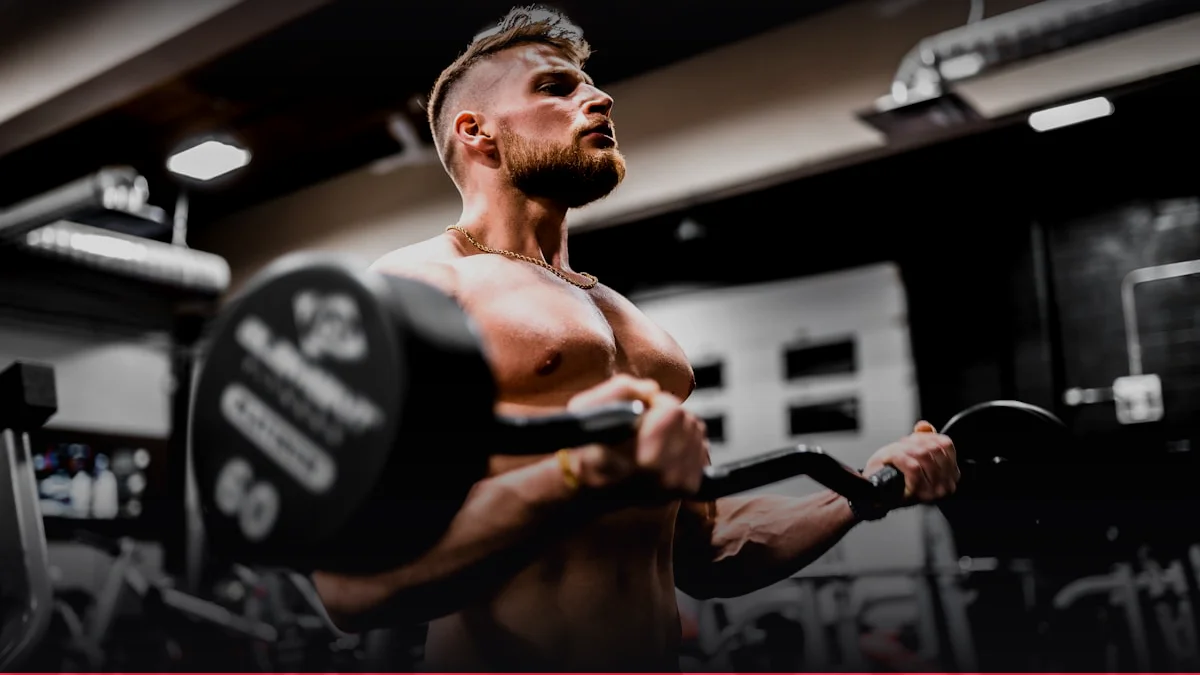
The dumbbell press is a multi-joint exercise that engages a large number of upper body muscles.
- Anterior Deltoid
- The primary target muscle. Responsible for lifting the arm upward and stabilizing the weight overhead.
- Middle Deltoid
- Actively works with a wide elbow placement. This adds the desired width to the shoulders.
- Triceps
- Perform elbow extension in the upper phase of the movement, locking out the dumbbells.
- Upper Trapezius
- Stabilizes the scapula during the lift. It is important to control its tension so it doesn't take over the work of the delts.
- Core Muscles
- Maintain the spine in a stable state, preventing excessive lower back arching.
Biomechanical Mechanics: Biomechanically, the dumbbell press has an advantage in its **natural trajectory**. Unlike the barbell, dumbbells allow the arms to move in an arc, converging at the top point. This ensures a full deltoid contraction and allows the weight to be lowered deeper, stretching the muscle fibers. Furthermore, you can vary the grip (from neutral to pronated), allowing for shifting emphasis across different parts of the deltoid.
4. Biochemical Impact: A Powerful Anabolic Stimulus
The seated dumbbell press is an exercise that allows for working with significant weights, creating substantial mechanical stress for muscle cells. This triggers a cascade of biochemical reactions related to mTOR activation and increased protein synthesis.
Biochemically, working in an 8-12 repetition range leads to lactate accumulation in the shoulder girdle. This creates metabolic stress that promotes the release of local growth factors (IGF-1). Since the exercise engages multiple joints and large muscle groups (delts + triceps), the systemic response in terms of growth hormone levels is quite pronounced.
The seated dumbbell press is a hormonal explosion for your shoulders. Use foundational strength to build elite musculature.
It is also important to mention the impact on the CNS. The constant need to stabilize each dumbbell independently forces the brain to send more intense signals to the muscles, improving motor unit recruitment. This makes the delts not just larger, but stronger in terms of neuromuscular coordination.
Seated Dumbbell Shoulder Press 1RM & Path
Calculate per-hand dumbbell 1RM, scapular plane alignment (30-45°), and bilateral barbell equivalent.
Launch Tool5. Practical Methodology and Execution Technique
For the dumbbell press to be safe and effective, technique must be honed.
- Starting Position: Sit on a bench with a vertical backrest (or a slight incline). Lift the dumbbells to shoulder level. Palms should face forward, elbows pointed out and slightly forward (at a 30-degree angle from the plane of the body).
- Lift: On an exhale, use a powerful but controlled movement to press the dumbbells upward in an arc. At the top, they should be over your head but not touching.
- Important Nuance: Do not lock out your elbows completely. Keep a slight bend to maintain tension in the delts.
- Descent: Slowly and smoothly lower the dumbbells to chin level or slightly below. Feel the stretch in the delts.
- Back Position: Keep your lower back pressed against the bench. Avoid excessive arching!
| Parameter | Recommended Value | Effect |
|---|---|---|
| Repetitions | 8-12 | Strength hypertrophy |
| Tempo (Eccentric) | 3 seconds | Increase in Time Under Tension (TUT) |
| Sets | 3-4 | Optimal volume for shoulders |
| Grip | Pronated (palms forward) | Maximum activation of anterior and middle delts |
6. Load Progression and Integration
In the dumbbell press, progression should occur primarily through increasing the working weight. Since shoulders are prone to overload, add weight gradually (1-2 kg).
- Increasing Range: If you are already working with heavy weights, try lowering the dumbbells another 2-3 cm—this provides a new stimulus for growth without adding weight.
- Pauses at the Bottom: Perform a 2-second stop at the moment of maximum stretch. This completely eliminates momentum.
- Drop Sets: Perform 10 reps with heavy dumbbells, then immediately take dumbbells 30% lighter and do another 8. This creates an incredible pump.
- Parallel Grip: Try a dumbbell press with palms facing each other. This shifts the emphasis to the anterior head and relieves pressure on the shoulder joint.
Important: The seated dumbbell press is a compound exercise that should be placed first on shoulder day. This allows you to work with maximum weights while your triceps and delts are fresh.
Do not chase records in the dumbbell press. What matters is how you control the weight at every centimeter of the trajectory.
7. Analysis of Scientific Research and Evidence Base
EMG (electromyography) studies confirm that the seated dumbbell press provides 10-15% higher activation of the middle deltoid compared to the seated barbell press. This is due to the need to stabilize each arm independently and the greater freedom in elbow positioning.
Scientific papers on shoulder joint health indicate that the dumbbell press is safer for individuals with a narrow subacromial space because it allows the arm to move in the most comfortable plane (scapular plane). This significantly reduces the risk of developing impingement syndrome.
Scientists also investigated the role of the seated position. It was found that the seated press loads the spinal extensors 30% less than the standing press, allowing the athlete to better concentrate on deltoid work without being distracted by maintaining whole-body balance.
8. Synergy: Nutrition, Nutraceuticals, and Recovery
Recovering after heavy overhead presses requires nutrients that support both muscle and connective tissue.
- Creatine Monohydrate
- Provides strength for heavy sets and promotes water retention in muscle cells, enhancing the pump.
- Glucosamine and Chondroitin
- Shoulder joints undergo serious pressure in presses. Support for cartilage tissue is mandatory for athlete longevity.
- Citrulline Malate
- Allows for more repetitions in a set by delaying deltoid acidification.
- Magnesium
- Helps relax muscles and the CNS after a heavy strength session.
Recovery should include MFR (myofascial release) of the upper back and stretching of the pectoral muscles. Since shoulder presses are often accompanied by trapezius tension, light neck and shoulder area stretching will help avoid congestion.
9. Common Mistakes, Myths, and Injury Prevention
The main mistake is "clanging" the dumbbells together at the top. This adds no benefit but creates vibrations transmitted to the joints and momentarily removes tension from the muscles.
- Myth: The seated dumbbell press is worse than the standing barbell press for mass. (Reality: It is better for isolation and deltoid proportions).
- Mistake: Excessive lower back arching. This turns a shoulder press into a form of incline chest press and injures the spine.
- Myth: You should only lower the dumbbells to ear level. (Reality: For full activation, it is better to lower to chin level, flexibility permitting).
- Mistake: Using momentum (leg drive). While hard to do seated, some athletes try to "kick" the weight with their torso.
To prevent injury, always start with a thorough warm-up of the rotator cuff. If you feel sharp pain when lowering the dumbbell, stop and reduce the range or weight.
Interactive Apps & Calculators for Article
Empirical mathematical algorithms and scientific formulas for sports optimization
 Strength & Hypertrophy
1RM & Bench Press Calculator
Calculate your One-Rep Max using 7 scientific formulas, percentage table (50-95%), and barbell plate loader visualizer.
 Strength & Hypertrophy
VBT Velocity Based Training
Determine % 1RM and target strength zones from mean barbell velocity (m/s).
10. FAQ: Answers to Common Questions
- Can I perform the dumbbell press without a backrest?
- It is possible and will significantly strengthen your core, but you won't be able to work with the same heavy weights for the delts as you would with support.
- What is the best bench incline angle?
- Optimally 80-90 degrees. If the angle is less than 75 degrees, the load begins to shift too much to the upper chest.
- Why does my shoulder click during the press?
- This can be a sign of joint instability or tendon inflammation. Try rotating your elbows slightly forward (neutral grip) and see if the sound disappears.
- Is it mandatory to straighten the arms completely?
- For the triceps, yes; for the delts, it's better to stop 5-10 degrees before full extension to keep the muscle under constant tension.
- Is the dumbbell press suitable for women?
- Absolutely. It is one of the best exercises for creating a beautiful shoulder line and improving posture.
The seated dumbbell press is the foundation of your future victories in the gym. Be consistent, work on your technique, and your shoulders will reward you with power and ideal form.