

Dumbbell Shrugs: Definition and Precise Trapezius Training
1. Introduction and Relevance
If you aim to build a powerful and complete shoulder girdle, you cannot ignore the trapezius muscles. While barbell shrugs allow for working with maximum weights for overall mass, **Dumbbell Shrugs** are an unsurpassed tool for precise isolation and detailing of the upper back. Dumbbells allow you to keep your hands at your sides, which is the most natural position for the shoulder joints and ensures a greater range of motion.
The relevance of dumbbell shrugs in modern training is driven by the possibility of correcting asymmetries and improving neuromuscular control. Unlike the barbell, where the stronger side might take over a portion of the load, dumbbells force each trapezius to work independently. This is critical for correcting postural defects and creating a symmetrical, athletic silhouette. Furthermore, dumbbell shrugs are significantly more comfortable for high-rep performance, which is key to this muscle's hypertrophy.
In this article, we will examine the biomechanical advantages of using dumbbells for trapezius training in detail, learn how to use torso tilt to shift loading emphasis, and discover how to structure training so your neck and shoulders look powerful and healthy.
2. History and Evolution
Shrugs with weights in hand have been known since the dawn of athleticism. At the beginning of physical culture, strongmen used heavy stone blocks or awkward kettlebells to strengthen the shoulder girdle. With the advent of adjustable dumbbells in the first half of the 20th century, the exercise took its modern form. "Silver Era" bodybuilders, such as Steve Reeves, used dumbbell shrugs to create a wide yet elegant silhouette where the trap did not look overly bulky but added power.
The evolution of the exercise led to the understanding that the trapezius is not just a muscle that lifts the shoulders upward, but also a stabilizer of the scapula in various planes. In the 80s, athletes began experimenting with leaning the torso forward, allowing for the engagement of not only the upper but also the middle trapezius head. This made the exercise more complex and effective for creating back "thickness."
Today, dumbbell shrugs are viewed as a safe and functional alternative to barbell shrugs. Modern sports medicine recommends the dumbbell version for individuals with lower back or cervical spine issues, as they allow for maintaining a more neutral spine position and avoiding dangerous forward head protrusion.
3. Anatomy and Biomechanics of the Scapula
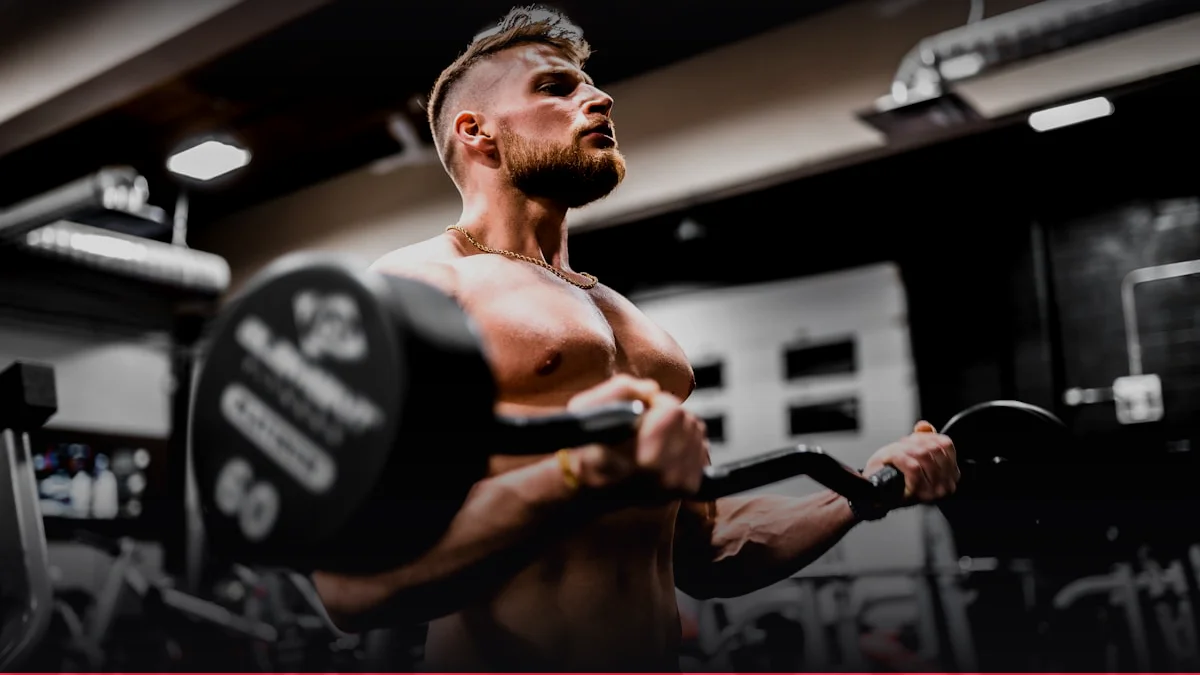
The trapezius is one of the largest muscles of the upper body, and dumbbell shrugs focus on its functional characteristics.
- Upper Trapezius
- The primary mover. Responsible for scapular elevation (lifting). This creates the visual volume near the neck.
- Middle Trapezius and Rhomboids
- Engaged with a slight forward torso lean and by retracting the shoulder blades. They add depth to the back.
- Levator Scapulae
- Lies deeper and assists the trapezius in lifting the weight. Excessive tension here is often the cause of neck pain.
- Forearms (Grip)
- Bear a large isometric load while holding the dumbbells throughout the set.
Biomechanical Mechanics: Biomechanically, dumbbell shrugs have an advantage in the **line of pull**. Since the dumbbells are at the sides rather than in front of the thighs, the force vector passes directly through the center of the shoulder joint. This allows the scapula to move along its natural trajectory upward and slightly backward, which perfectly matches the direction of the trapezius muscle fibers.
4. Biochemical Impact: Constant Tension
The trapezius contains a high percentage of mixed-type muscle fibers. This means it responds well to both strength work and metabolic stress. Dumbbell shrugs allow for an ideal combination of these two factors.
Biochemically, working in a 12-15 repetition range with an emphasized pause at the top leads to the accumulation of lactate and tissue acidification. Since the trapezius is a highly vascular muscle, this causes a powerful pump. High metabolic stress levels stimulate the production of growth factors and increase the number of mitochondria in muscle cells.
Traps love the "burn." If you finish a set without feeling fire in the muscles, you haven't worked hard enough.
It is also important to mention the impact on the CNS. Holding heavy dumbbells for 40-60 seconds stimulates proprioceptors, improving the stability of the entire shoulder girdle. This creates a solid neuromuscular foundation for performing more complex exercises, such as overhead presses or deadlifts.
Incline Dumbbell Press Angle & Clavicular Load
Calculate clavicular pec activation vs anterior delt loading and estimated dumbbell 1RM based on incline angle.
Launch Tool5. Practical Methodology and Execution Technique
For dumbbell shrugs to be effective, technique must be strict. Do not attempt to copy "shoulder jerking" with massive weights.
- Starting Position: Take the dumbbells and stand with your feet shoulder-width apart. Hold the dumbbells at your sides (neutral grip). Keep your back straight, chest out, and gaze strictly forward.
- Lift: On an exhale, lift your shoulders as high as possible toward your ears. Arms should remain completely straight. Do not bend your elbows!
- Important Nuance: Try not just to lift the shoulders, but also to slightly retract the shoulder blades at the top point. This engages more fibers.
- Peak Contraction: Hold at the top for 2 seconds, maximally tensing the traps.
- Descent: On an inhale, smoothly lower the dumbbells, feeling the muscle stretch. Do not drop the weight!
| Parameter | Recommended Value | Effect |
|---|---|---|
| Repetitions | 12-20 | Metabolic stress and hypertrophy |
| Tempo | 2-2-1 (lower-pause-lift) | Control and Time Under Tension |
| Sets | 3-5 | Sufficient volume for growth |
| Grip | Using straps (optional) | Focus on the traps, not the grip |
6. Load Progression and Integration
Progression in dumbbell shrugs should be gradual. Since dumbbell weights in most gyms are limited, you should use other methods to increase intensity.
- Reducing Rest Time: Try resting for only 30-45 seconds between sets. This will critically increase the metabolic response.
- Adding a Lean: Perform shrugs with a slight forward torso lean (10-15 degrees). This shifts the emphasis to the middle part of the trapezius and adds back thickness.
- Stretch Pause Method: Hold at the bottom for 3 seconds, allowing the dumbbell weight to maximally stretch your traps.
- Supersets: Pair dumbbell shrugs with lateral raises. This will "fry" your shoulders and traps in one cycle.
Important: Dumbbell shrugs are ideal for finishing a shoulder or back workout. Since they fatigue the lower back less than the barbell version, you can perform them even after heavy compound exercises without fearing a loss of torso stability.
Dumbbells allow you to "sculpt" the shape of the trapezius as if you were a sculptor working on a statue.
7. Analysis of Scientific Research and Evidence Base
EMG (electromyography) studies confirm that dumbbell shrugs provide 15-20% higher activation of the upper trapezius compared to barbell shrugs held in front of the body. This is due to the more physiological hand position, allowing the scapula to achieve a full range of upward motion.
Scientific papers on the role of the trapezius in posture have shown that strengthening the upper and middle heads through shrugs helps balance the strength of the pectoral muscles, preventing rounded shoulders (the "office posture" prototype). However, scientists emphasize the importance of not protruding the head forward during the lift to avoid compressive loading on the cervical discs.
An interesting study in the *Journal of Orthopaedic Science* indicated that isometric weight holding in shrugs promotes the strengthening of the acromioclavicular joint ligaments, making the shoulder girdle more resistant to injury during falls or collisions in sports.
8. Synergy: Nutrition, Nutraceuticals, and Recovery
The trapezius is a massive muscle requiring plenty of nutrients for regeneration. Since we are working on definition, the diet should support a low body fat percentage for visible results.
- Creatine
- Allows for maintaining strength endurance during high-rep sets.
- Beta-Alanine
- Helps combat acidification, which is important for achieving that "burn" in the traps.
- Glucosamine and Chondroitin
- Support the health of the shoulder joints, which bear a heavy load during stretching with heavy dumbbells.
- Magnesium
- Promotes neck muscle relaxation after training, preventing tension headaches.
Recovery after shrugs should include gentle neck and trapezius stretching. It is also beneficial to use MFR (myofascial release) with a tennis ball on the area between the shoulder blades to remove trigger points that often occur in the traps due to heavy loading.
9. Common Mistakes, Myths, and Injury Prevention
The main mistake is rolling the shoulders. Many athletes roll their shoulders forward or backward under load, believing it works the muscle better. This is a MYTH and a DIRECT PATH TO INJURY. The shoulder joint is not designed for rotation under heavy weight; the movement should be strictly vertical.
- Myth: Shrugs will make the neck look short. (Reality: They make the shoulders look powerful, creating a masculine silhouette).
- Mistake: Leg assistance (cheating). If you are jumping with the dumbbells, the traps aren't working.
- Myth: The heavier the weight, the better. (Reality: The trapezius responds best to control and a pause at the top, not mindless weight).
- Mistake: Protruding the chin forward. This creates dangerous pressure on the neck. Keep your head straight!
To prevent injury, always start with weights you can confidently hold at the top for 2 seconds. If your grip is weak, use straps. Your goal is to train the trapezius, not grip strength.
Interactive Apps & Calculators for Article
Empirical mathematical algorithms and scientific formulas for sports optimization
Endurance & Cardio
Seated Dumbbell Shoulder Press 1RM & Path
Calculate per-hand dumbbell 1RM, scapular plane alignment (30-45°), and bilateral barbell equivalent.
 Strength & Hypertrophy
Barbell Shrugs: Scapular Elevation & Trapezius Load
Biomechanical breakdown of barbell shrugs: upper trapezius force vector, levator scapulae recruitment, and cervical spine axial safety.
10. FAQ: Answers to Common Questions
- Which is better: dumbbell shrugs or barbell shrugs?
- Dumbbells are better for isolation and joint health. Barbells are for working with extreme weights. It's best to alternate these exercises monthly.
- Can I do shrugs while seated?
- Yes, it's a good option for full isolation as it eliminates leg assistance. However, it's harder to handle very heavy weights seated due to dumbbell positioning.
- Why does my neck hurt after shrugs?
- You are likely tensing your neck muscles too much or protruding your head forward. Try relaxing the neck and focusing only on lifting the shoulder blades.
- Can I develop traps without shrugs?
- They work in deadlifts and raises, but for maximum upper head hypertrophy, shrugs are indispensable.
- How many times a week should I do shrugs?
- The trapezius recovers quickly. 1-2 times per week on back or shoulder days is quite sufficient.
Dumbbell shrugs are surgical work on your shoulder girdle. Be technical, be patient, and your results will surprise even you.