

Barbell Shrugs: Building Powerful Traps
1. Introduction and Relevance
Powerful, well-developed traps are the hallmark of any serious athlete. They not only create an impressive silhouette but also play a critical role in stabilizing the shoulder girdle and protecting the cervical spine. **Barbell shrugs** are a fundamental exercise for developing the upper portion of the trapezius muscle. Unlike many other movements, shrugs allow for the use of extremely heavy weights, providing a potent stimulus for hypertrophy and connective tissue strengthening.
The relevance of this exercise extends far beyond bodybuilding. In powerlifting and Olympic lifting, strong traps are necessary for holding the bar during deadlifts and performing pulls. In contact sports such as rugby or wrestling, a massive trapezius serves as a natural shock absorber, protecting the neck from impact injuries. Even for office workers, shrugs (with moderate weight) can be beneficial for improving blood circulation in the neck and shoulder area and preventing slouching.
In this article, we will examine the biomechanics of barbell shrugs in detail, learn to distinguish effective techniques from dangerous mistakes, and understand how to structure your training process to turn your shoulders into a true "stone wall."
2. History and Evolution
Shrugs, or shoulder elevations, have been known since the "physical culture" era of the late 19th century. Old masters of strength, such as Eugen Sandow and George Hackenschmidt, used this movement to demonstrate the incredible toughness of the shoulder girdle. At that time, the exercise was performed primarily with kettlebells or heavy dumbbells, as barbells did not yet have a convenient design for such an isolated movement.
The evolution of shrugs in the modern sense began in the mid-20th century with the advent of the Olympic barbell. Golden Era bodybuilders realized that the barbell allowed for significantly more weight than dumbbells, leading to modifications: shrugs in front of the body and shrugs behind the back (popularized by Lee Haney). The exercise became an integral part of back or shoulder splits, establishing itself as the premier builder of the upper traps.
Today, barbell shrugs have evolved toward greater safety. We have moved away from dangerous shoulder rotations (rolling the shoulders) in favor of a linear, strictly vertical lift. Smith machines and specialized trap bars have emerged, allowing for shrugs with a more physiological hand position; however, the classic barbell remains the gold standard due to its accessibility and maximum strength potential.
3. Anatomy and Biomechanics of the Shoulder Girdle
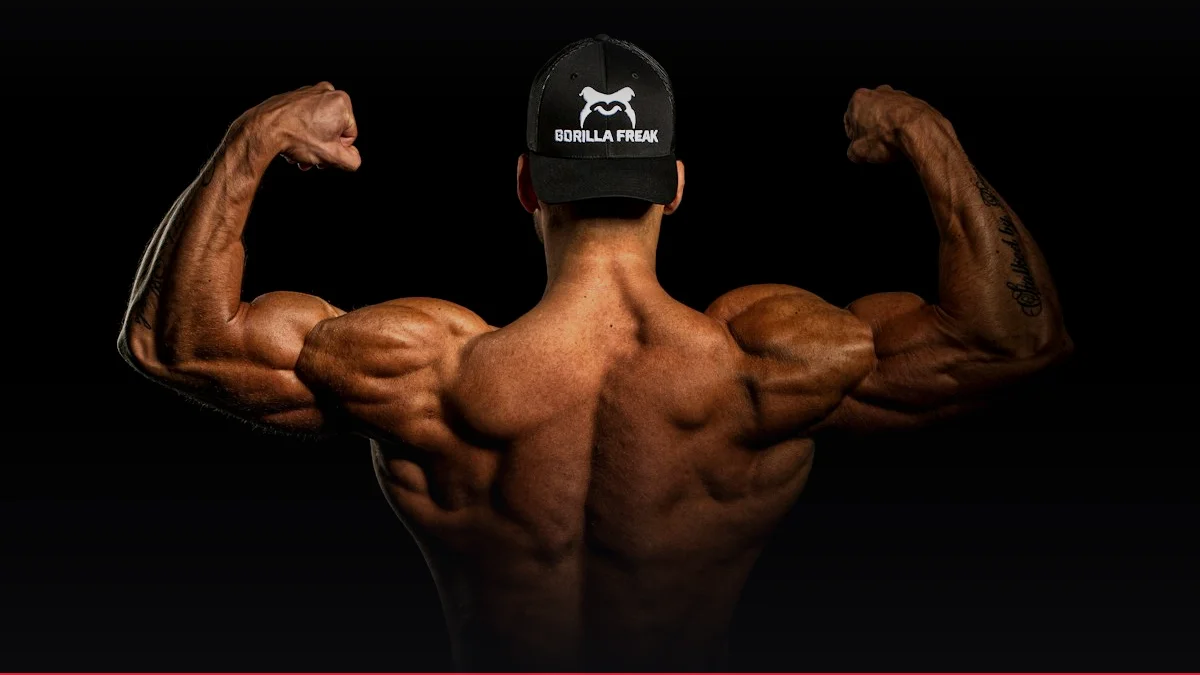
To understand the exercise, it is important to know the structure of the trapezius muscle. It is a large triangular muscle divided into three parts, and shrugs focus specifically on the upper part.
- Upper Trapezius
- Originates from the base of the skull and the cervical vertebrae, inserting into the lateral third of the clavicle. Its primary function is scapular elevation and stabilization.
- Levator Scapulae
- Lies beneath the trapezius and actively assists in shrugs by lifting the superior angle of the scapula.
- Rhomboids
- Engage during scapular retraction at the top point of the shrug, helping to stabilize the weight.
- Forearms
- While not a target group, the forearm muscles bear a colossal isometric load while holding a heavy barbell.
Biomechanical Mechanics: Biomechanically, shrugs are a pure vertical elevation of the scapulae. Since the scapula is not rigidly fixed to the skeleton but is held by muscles, shrugs create a direct force vector that stretches and compresses the trapezius fibers along their entire length. It is important that the movement occurs in the scapular plane, which is slightly forward of a pure lateral plane.
4. Biochemical Impact: Strength Adaptation Stress
Barbell shrugs are an exercise with immense strength potential. Using weights that often exceed the athlete's own body weight creates a unique type of **mechanotransduction**. The heavy load literally "stretches" the muscle fibers and fascia, activating mechanoreceptors that trigger protein synthesis and myogenesis.
From an endocrinological perspective, heavy shrugs combined with other compound movements contribute to a short-term increase in testosterone and growth hormone levels in the blood. Significant activation of proprioceptors in the cervical region is also observed, improving neuromuscular coordination of the entire upper body.
The trapezius is a muscle that "feeds" on heavy weights. Without strength stress, it will never become massive.
Biochemically, working in an 8-12 repetition range leads to the accumulation of metabolites in the upper back. Since the trapezius has an excellent blood supply, it responds quickly to this stress by increasing sarcoplasmic and myofibrillar volume. Isometric holding of the barbell also strengthens tendon structure, which is important for the athlete's overall strength stability.
Barbell Shrugs: Scapular Elevation & Trapezius Load
Biomechanical breakdown of barbell shrugs: upper trapezius force vector, levator scapulae recruitment, and cervical spine axial safety.
Launch Tool5. Practical Methodology and Execution Technique
Proper technique in shrugs is a balance between range of motion and weight. Many make the mistake of taking too much weight and only twitching the bar a couple of centimeters.
- Starting Position: Stand with feet shoulder-width apart. Grip the barbell with an overhand grip (palms facing you) slightly wider than shoulder-width. Stand tall, chest out, shoulders slightly down and spread.
- Initial Movement: On an exhale, lift your shoulders as high as possible, as if trying to touch them to your ears. Important: arms must remain straight; do not bend your elbows!
- Peak Contraction: At the top point, pause for 1-2 seconds, maximally squeezing the traps.
- Descent: On an inhale, smoothly lower the barbell, feeling the stretch in the muscles. Do not drop the weight abruptly!
- Range of Motion: Aim to work in the maximum available range. The lower you drop the shoulders in the starting phase, the more fibers you will engage.
| Parameter | Recommended Value | Effect |
|---|---|---|
| Repetitions | 8-12 | Optimal for hypertrophy |
| Grip | Closed / using lifting straps | Straps allow focus on the traps rather than grip |
| Tempo | 2-1-2 (lower-pause-lift) | Control and Time Under Tension |
| Training Frequency | 1-2 times per week | Time for CNS and muscle recovery |
6. Load Progression and Integration
Progression in shrugs is very linear. You can add 2.5-5 kg every 2 weeks as long as your technique remains perfect. When the weight becomes critical for your hands, be sure to use lifting straps. Your goal is to train the traps, not grip strength (there are separate exercises for grip).
Important: Shrugs are best placed after back or shoulder exercises. If you do them on back day, place them after bent-over rows. If on shoulder day, after overhead presses. This is logical since the traps will already be warmed up and ready for heavy work.
An alternative integration option is performing shrugs in a Smith machine. This eliminates the need to stabilize the bar in the horizontal plane and allows full focus on the vertical lift. You can also try the behind-the-back version of shrugs, which emphasizes the middle part of the trapezius and the rhomboids.
Shrugs are the final chord in creating a powerful torso. Do not ignore them if you want to look solid.
7. Analysis of Scientific Research and Evidence Base
EMG studies show that barbell shrugs in front of the body provide maximum activation of the upper trapezius compared to any other exercise. Interestingly, a slight forward torso tilt (10-15 degrees) can further increase activation as it aligns the trapezius fibers parallel to the gravity vector.
Scientific papers on shoulder rolling during shrugs unambiguously point to its harm. Rotating the shoulder joint under heavy load creates unnecessary friction in the acromioclavicular (AC) joint and can lead to labral wear. Only vertical movement is biomechanically justified and safe.
Scientists have also researched the role of isometric pauses. It was found that holding the weight at the top for 2-3 seconds increases motor unit recruitment time by 25%, which is critical for overcoming adaptation plateaus in experienced athletes.
8. Synergy: Nutrition, Nutraceuticals, and Recovery
The heavy weight used in shrugs creates significant stress not only on the muscles but also on the ligaments and spine. Therefore, the diet should contain sufficient collagen and micronutrients for connective tissue regeneration.
- Glucosamine and Chondroitin
- Help maintain the health of intervertebral discs and shoulder joints during regular work with heavy weights.
- Magnesium
- Necessary for relieving neck muscle hypertonicity after training, helping to avoid "tension headaches."
- Vitamin C
- Facilitates collagen synthesis, strengthening the trapezius tendons.
- Protein (2g/kg)
- The foundation for building new myofibrils in a muscle as massive as the trapezius.
Recovery should also include stretching the neck and trapezius muscles after sets. This helps normalize blood flow and prevents excessive tissue stiffness, which can limit head mobility.
9. Common Mistakes, Myths, and Injury Prevention
The main danger in shrugs is protruding the head forward ("goose neck") during the lift. This creates colossal pressure on the cervical vertebrae and can lead to herniated discs or pinched nerves. Keep your chin slightly tucked and your gaze directed forward.
- Myth: Shrugs will make the neck too short. (Reality: They make the shoulders massive, which visually enhances the athlete's silhouette).
- Mistake: Using leg drive (cheating). If you bounce the bar with your legs, the traps do not receive the necessary load.
- Myth: You must roll the shoulders for "full development." (Reality: This is a direct path to shoulder injury).
- Mistake: Bending the arms at the elbows. This transfers part of the weight to the biceps, which are significantly weaker than the traps and can be injured.
To prevent injury, always use a weightlifting belt if the weight of the barbell exceeds 80% of your own body weight. This will help stabilize the core and protect the lower back.
Interactive Apps & Calculators for Article
Empirical mathematical algorithms and scientific formulas for sports optimization
Strength & Hypertrophy
Barbell & Pendlay Row 1RM Calculator
Estimate barbell and Pendlay row 1RM, maintain 1:1 push-pull balance, and protect rotator cuff integrity.
 Strength & Hypertrophy
1RM & Bench Press Calculator
Calculate your One-Rep Max using 7 scientific formulas, percentage table (50-95%), and barbell plate loader visualizer.
10. FAQ: Answers to Common Questions
- Which is better: barbell shrugs or dumbbell shrugs?
- The barbell allows for more weight, which is better for strength. Dumbbells allow the hands to be kept at the sides of the torso, which is more natural for the shoulder joints. It's best to alternate between these options.
- Can shrugs be done seated?
- This is possible with dumbbells to eliminate torso momentum. With a barbell, it is technically inconvenient due to the space constraints between the legs and the bar.
- Which grip is better: overhand or mixed grip?
- Only an overhand grip with straps. A mixed grip in shrugs can lead to asymmetrical loading on the spine and neck, which is undesirable.
- Why do I get a headache after shrugs?
- This may be a sign of neck muscle overstrain. Check your technique (are you pulling your head forward?) and perform gentle stretching after the workout.
- Can I develop traps with just deadlifts?
- Deadlifts excellently strengthen the traps isometrically, but for maximum hypertrophy of the upper portion, a dynamic movement like shrugs is required.
Barbell shrugs are a time-tested tool for creating a powerful and healthy body. Work hard but smart, and your traps will be your pride.