


Sensory System and Proprioception: The Internal Sense of Movement
1. Introduction and Relevance
In the world of athleticism, we often focus on muscle strength and cardiac endurance, but we forget the system that coordinates our every step—the **sensory system** and its key component, **proprioception**. Proprioception is the human "sixth sense," the ability to perceive the position of body parts in space and relative to each other without visual control. It is a complex feedback mechanism between the brain and thousands of receptors located in muscles, tendons, and joints.
The relevance of this topic for sports is critical. Without developed proprioception, even the strongest athlete will be clumsy, and the risk of injury will increase exponentially. Proprioception is responsible for balance, precision of movement, and the body's ability to instantaneously adapt to unstable surfaces or changes in direction. In modern fitness, dominated by fixed-trajectory machines, we often lose this natural skill, leading to a degradation of movement intelligence.
In this article, we will examine the physiological foundations of sensory control, learn how the brain processes signals from proprioceptors, and understand how to train this "sixth sense" to achieve perfect technique and maximum safety in sports.
2. History and Evolution
The term "proprioception" was introduced by Charles Sherrington in 1906, for which he later received the Nobel Prize. Before this, scientists viewed body awareness as part of general tactile sensitivity. Sherrington was the first to realize that the organism has an internal system for monitoring tissue tension and length that operates independently of external stimuli.
Evolutionarily, proprioception developed as a survival mechanism. Our ancestors needed to run across rugged terrain, hunt, and climb trees, where every error in foot placement could be fatal. In the 20th century, the study of proprioception moved from neurologists' offices to training halls. In the 1960s, the first balance platforms and neuromuscular re-education methodologies began to appear, initially for post-injury rehabilitation and later for elite athlete preparation.
Today, we are in the era of "neuroathletics." Modern coaches realize that the limiting factor for strength is often not the muscle but the brain, which restricts output due to poor sensory input. The evolution of this field has led us to understand that training the brain and receptors is as important a component of success as lifting heavy weights.
3. Anatomy and Biomechanics of Sensory Control
The primary players in the proprioception system are three types of receptors. They are located in different tissues and perform specific monitoring functions.
- Muscle Spindles
- Located parallel to muscle fibers. They respond to the speed and degree of muscle stretch. They are responsible for triggering the "myotatic reflex" (stretch reflex), which protects the muscle from tearing during sudden elongation.
- Golgi Tendon Organs (GTOs)
- Found at the junction of the muscle and tendon. They are sensitive to tension (force). When tension becomes critical, they send a signal to relax the muscle, acting as a safety fuse.
- Joint Receptors
- Located in joint capsules and ligaments. They determine the joint angle and internal pressure, helping the brain form a spatial map of the body.
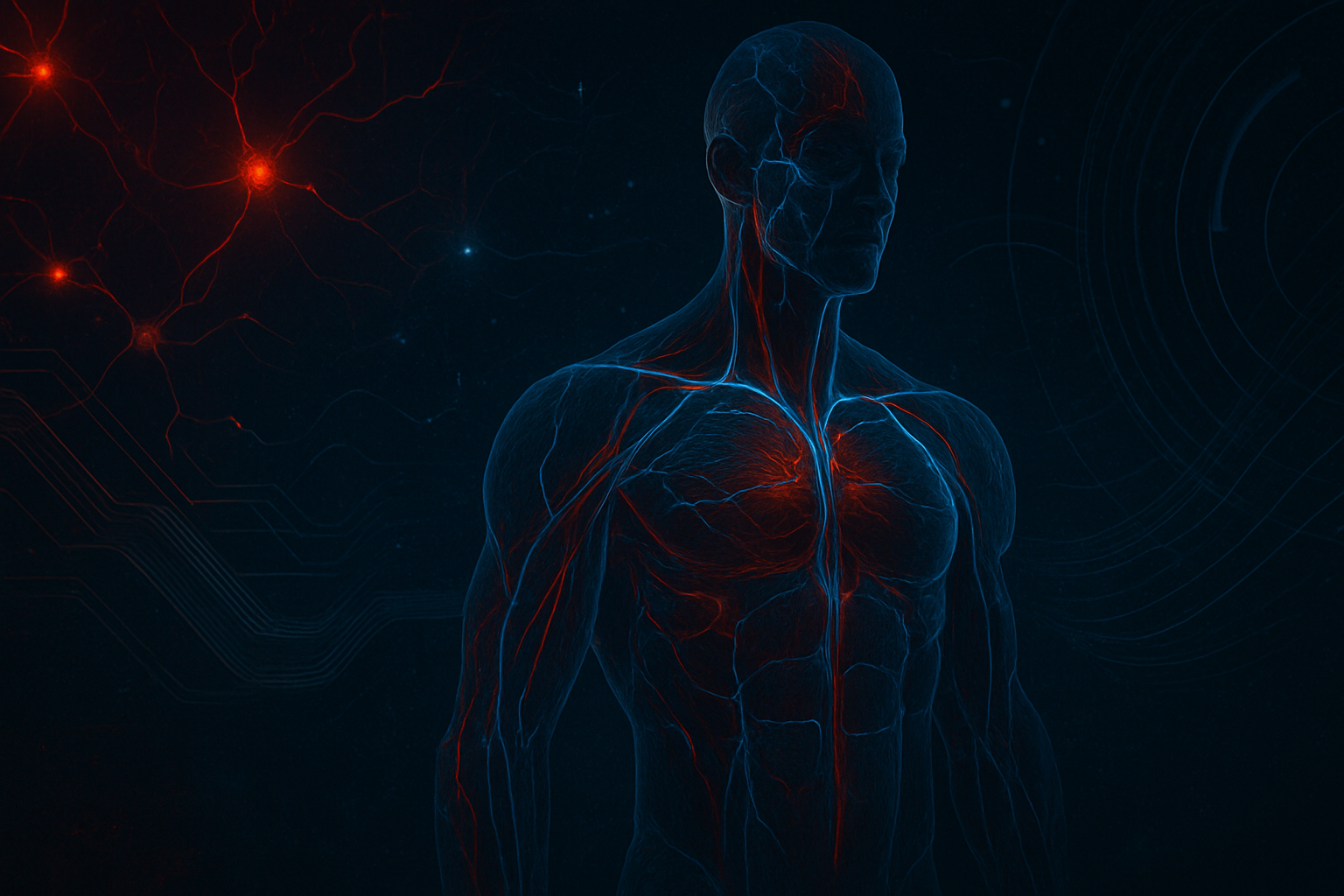
Biomechanical Mechanics: Biomechanically, proprioception operates through a feedback loop. Signals from receptors travel via afferent nerves to the spinal cord and cerebellum (the coordination center), where they are processed in milliseconds. The brain instantaneously adjusts the tone of stabilizer muscles to maintain balance. This occurs at a subconscious level, allowing us to focus on the external goal of movement rather than the process of staying balanced.
4. Biochemical Impact: Neurotransmitters and Plasticity
The functioning of the sensory system is inextricably linked to neurochemistry. The speed of signal transmission from receptor to brain depends on the quality of the myelin sheath of nerves and the concentration of key neurotransmitters such as **acetylcholine**, which is responsible for neuromuscular transmission.
With consistent proprioceptive training, structural changes occur in the brain—**neuroplasticity**. The number of synaptic connections increases in the areas responsible for motor control. This biochemically solidifies new motor skills, making them more economical. The cleaner the sensory signal (free from "noise" caused by pain or restrictions), the more effectively the brain can recruit muscle fibers, directly leading to gains in strength.
Strength is not just the volume of actin and myosin; it is, above all, the quality of the connection between your brain and every muscle fiber.
The sensory system is also influenced by cortisol levels. Chronic stress reduces receptor sensitivity, making movements less precise. Conversely, optimal dopamine levels increase attention to proprioceptive signals, allowing for faster mastery of complex technical elements.
DEXA 4-Compartment Body Composition Model
Model body mass into 4 compartments (bone mineral, water, essential fat, and skeletal muscle tissue) matching DEXA accuracy.
Launch Tool5. Practical Methodology and Proprioceptive Training Techniques
Proprioceptive training should be integrated into the warm-up or assigned to separate sessions. The primary principle is the creation of graded instability and depriving the brain of its usual reference points.
- Training with Eyes Closed: Eliminating the visual channel forces the brain to rely 100% on internal receptors. Try standing on one leg or performing light squats with your eyes closed.
- Unstable Surfaces: Using BOSU half-spheres, balance pads, or TRX straps activates small stabilizer muscles that typically "sleep" during machine training.
- External Perturbations: Working with a partner who attempts to gently push you off balance during an exercise.
- Complex Coordinative Movements: Juggling, kettlebell exercises where the center of gravity is constantly shifting, or work on a coordination ladder.
| Difficulty Level | Exercise | Target Zone |
|---|---|---|
| Basic | Single-Leg Stance (30 sec) | Ankle and Knee |
| Intermediate | Squats on a Balance Pad | Core Muscles and Hip Proprioception |
| Advanced | Single-Leg Deadlift with Eyes Closed | Vestibular Apparatus and Back Line |
| Elite | Single-Arm TRX Stability Drills | Shoulder Joint Stability |
6. Load Progression and Integration
In sensory system training, progression is measured not by weight but by the degree of uncertainty. We start on a solid floor with eyes open, then transition to eyes closed, then add an unstable surface, and finally combine all this with a strength movement.
Important: Proprioceptive training quickly fatigues the CNS. It should not be done at the end of a heavy workout when the brain is already tired. The best time is the beginning of the session (after a general warm-up) as part of specific nervous system preparation.
Integration: 5-7 minutes of balance exercises before the main strength block will significantly improve the quality of squats or presses, as the brain will better "see" the working angles.
Proprioception is the foundation upon which your pyramid of strength stands. If the foundation is shaky, the pyramid will never be tall.
7. Analysis of Scientific Research and Evidence Base
Modern research in the *Journal of Athletic Training* confirms that including proprioceptive exercises in a training program reduces the risk of anterior cruciate ligament (ACL) injuries by 40-60%. This happens because the brain learns to activate protective muscle contractions before the ligament reaches critical tension.
Scientific papers on "sensory deprivation" show that after just 2-3 weeks of immobilization (e.g., after an injury), the proprioceptive map of the corresponding area in the brain begins to "blur." This explains why, after injuries, people often feel uncertain in a joint even if it has healed anatomically.
Studies of elite gymnasts and ballet dancers demonstrate an incredible density of neural connections in the somatosensory cortex. This proves that proprioception is a skill that can be developed to an extraordinary level, allowing for the execution of complex acrobatic elements with computer-like precision.
8. Synergy: Nutrition, Nutraceuticals, and Recovery
To maintain high nerve signal speed, specific nutrition is required. The myelin sheath of nerves consists of fats, so a deficiency of healthy fatty acids in the diet is a direct path to slowed reaction times.
- Omega-3 (DHA/EPA)
- Critically important for neural membrane fluidity and signal transmission speed.
- B Vitamins (especially B12)
- Necessary for nerve fiber regeneration and the prevention of neuropathies.
- Phosphatidylserine
- A phospholipid that improves cognitive functions and attention to internal body signals.
- Hydration
- Even mild dehydration (1-2%) significantly impairs coordination and the brain's decision-making speed.
Sensory System Recovery: Sensory system recovery requires high-quality sleep. It is during the REM phase of sleep that motor memory consolidation occurs—the transfer of learned exercises from short-term to long-term memory. Massage and MFR also aid proprioception by relieving fascial tensions that can "drown out" signals from receptors.
9. Common Mistakes, Myths, and Injury Prevention
The biggest mistake is training balance to full failure. Unlike muscles, proprioception requires freshness. When stabilizers are tired, technique breaks down, and instead of learning a correct pattern, the brain remembers compensatory and often dangerous movements.
- Myth: Balance training is only for the elderly and circus performers. (Reality: It is a foundation for any sport, from bodybuilding to boxing).
- Mistake: Using overly complex balance boards without proper spotting. This often leads to ankle injuries.
- Myth: If I have good technique, I don't need proprioception. (Reality: Technique is realized proprioception).
- Mistake: Constant use of rigid supports (tapes, braces) without medical indication. This "turns off" the joint's own receptors, making it lazy.
To prevent injury, always start with the simplest exercises on the floor. If you cannot stand for 30 seconds on one leg with your eyes open, it is too early to step onto a BOSU or close your eyes.
Interactive Apps & Calculators for Article
Empirical mathematical algorithms and scientific formulas for sports optimization
Sports Nutrition
US Navy Body Fat Calculator
Accurately estimate body fat % and lean muscle mass from neck, waist, hip, and height measurements.
 Biohacking & Ergogenics
Endocrine Axis: Free Testosterone & SHBG Equilibrium
Vermeulen equation for free & bioavailable testosterone, Free Androgen Index (FAI), and testosterone-to-estradiol ratio balance.
10. FAQ: Answers to Common Questions
- Why do I feel dizzy during balance exercises?
- This can be a sign of a mismatch between the visual, vestibular, and proprioceptive systems. Gradually accustom the brain to the load, starting with short sessions.
- Can proprioception be developed in adulthood?
- Yes, the brain is plastic throughout life. Learning may proceed more slowly than in childhood, but regular exercise will yield tangible results in just a few weeks.
- What footwear is best for proprioceptive training?
- The best is barefoot or in minimalist shoes with a thin sole. Thick, cushioned sneakers are like thick gloves on your hands; you lose most of the signals from your feet.
- Do yoga and Pilates help with proprioception?
- Absolutely. They are among the best systems for developing internal sensitivity and control over every inch of the body.
- Why does a joint feel "foreign" after an injury?
- This is the result of "sensory amnesia." The brain has disconnected this zone to protect it from pain. You need to retrain it to "see" the joint through specific rehabilitation exercises.
Developing proprioception is an investment in your movement intelligence. By becoming more sensitive to your body's signals, you will open new horizons of strength, agility, and longevity in sports.